
Arkansas remains 49th in the country for births to teens
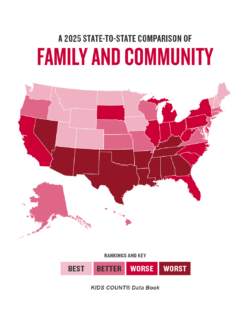
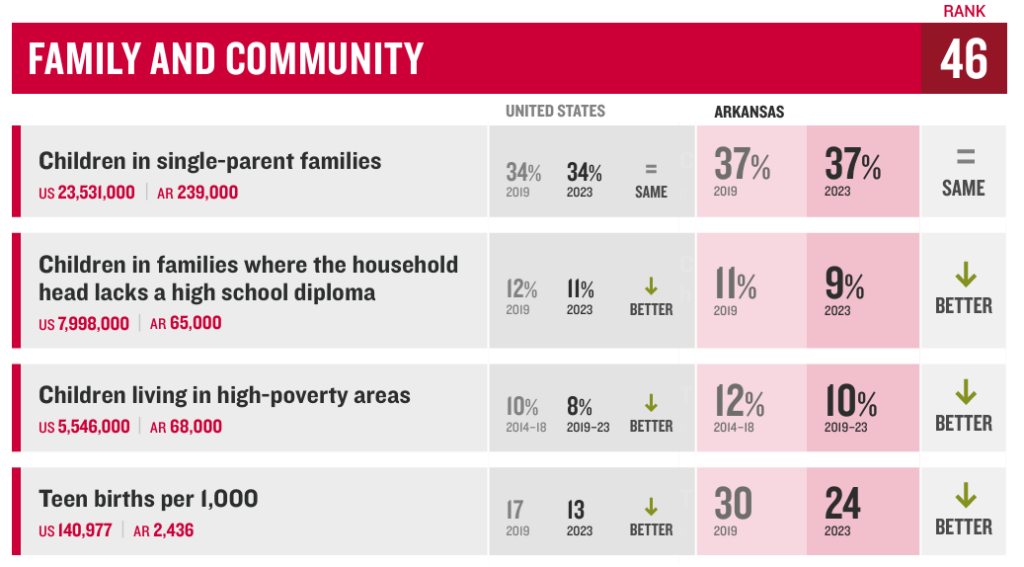
“Family and Community” is one of four domains the Annie E. Casey Foundation analyzes to determine whether children across the country are getting what they need to be successful and to thrive. Among the states across the nation, Arkansas ranks 46th in the Family and Community category in the 2025 KIDS COUNT® Data Book. While Arkansas has a long way to go, this ranking is meant to drive improvement rather than dwell on current deficits.
One indicator within the Family and Community domain that demands improvement is our teen birth rate. The teen birth rate measures the number of births to teenagers ages 15 to 19 per 1,000 females in this age group. To be fair, there is some good news regarding this indicator: Arkansas saw a roughly 45% decrease in the teen birth rate between 2013 and 2023 (the year for which we have the most current data). The bad news is that, even with this notable improvement, Arkansas still ranks 49th in the country with a teen birth rate of 24. By comparison, we are nearly double the current national teen birth rate of 13.
With such a significant decrease in the teen birth rate in our state over the last decade, why can Arkansas not improve its teen birth rate at the same rate as some other states? As Arkansas has made progress, other states have made more substantial improvement in lowering the teen birth rate with intentional policy decisions. These include, but are not limited to, encouraging evidence-based, medically accurate, and age-appropriate sexual health education in schools and increasing access to contraception. You can read more about the current state of sexual health education in Arkansas in our Sexual Health Education in Arkansas report.
Implementing policies designed to reduce the teen birth rate like these are critical to both the short and long-term well-being of women in this state and their children. For example, teens have a higher rate of neonatal and infant mortality and a higher risk of bearing low-birthweight and preterm babies. In addition, babies born to teenagers are more likely to be born into families with limited educational and economic resources. What’s more: having a baby as a teenager makes it more difficult to break out of the cycle of poverty — for both mom and baby. Being a teenage mom will hinder that young mother’s ability to complete high school, graduate from a post-secondary program, and otherwise attain economic mobility. Research also shows that children born to teen mothers are more likely to be raised in single-parent families, drop out of high school, and become teen parents themselves, thus also setting those children on a pathway to poverty. Finally, it’s also important to note that ongoing family planning services are critical even for teens who are already mothers because nationally 15% of teen births are a result of a mother’s second or higher-order pregnancy.
The intersection between teen pregnancy and poverty is complicated. However, to help reduce poverty and increase opportunities for children and families in our state, we must continue to reduce the teen birth rate. Let’s celebrate the progress we have made in Arkansas but also continue to implement strategies like providing access to contraception and offering evidence-based, medically accurate, and age-appropriate sexual health education in our schools and communities. Our children deserve it.