
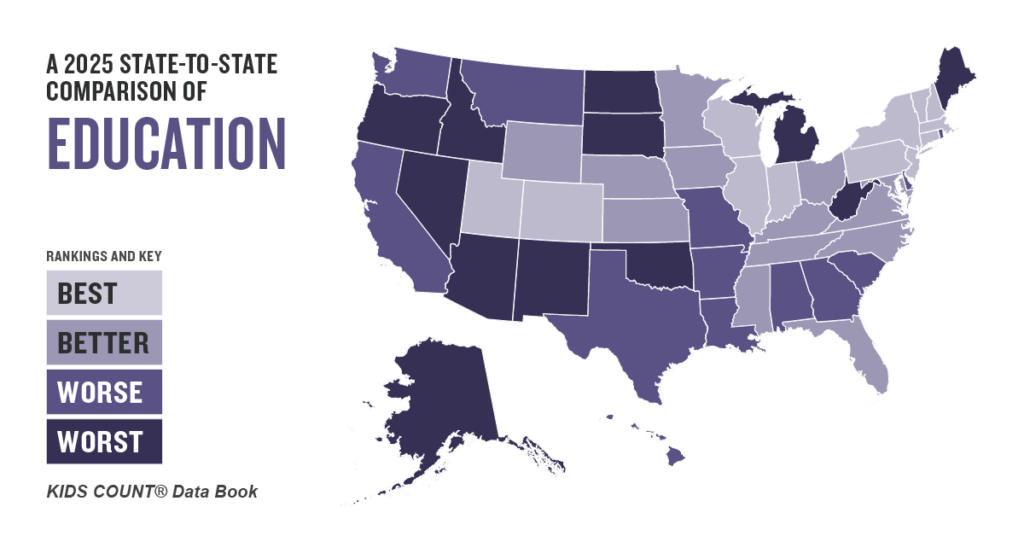
Arkansas ranks 36th in the nation for children’s education outcomes, according to the 2025 KIDS COUNT Data Book. This ranking highlights persistent disparities in opportunity and access that continues to limit outcomes for many students across the state. Despite policy changes and new education spending, gaps in support, achievement, and access remain wide.
The LEARNS Act: A Shift in Priorities
Passed in 2023, the LEARNS Act introduced Education Freedom Accounts (EFAs), which allow public education funds to be used for private and homeschool expenses. While the policy has been framed as an expansion of “school choice,” it has redirected a growing share of state resources away from public schools.
In its first year (2023–24), Arkansas spent nearly $35 million on EFAs, but 95 percent of participating students were already enrolled in private schools. Only about 18 percent had switched from public schools. By 2024–25, participation more than doubled to 14,297 students, at an estimated cost of $66.9 million, with just 27.5 percent coming from public schools. For the 2025–26 school year, nearly 37,000 students were approved for the program, and the state legislature allocated $277 million to cover costs.
While public schools did receive increases in teacher pay and the state funding formula, those increases were smaller by comparison. Public schools saw around $168 million in formula increases over two years and $183 million for teacher raises. In contrast, voucher spending alone is now projected to exceed $277 million annually. Critics argue that this shift in priorities is creating a two-track education system that benefits families already able to access private options, while leaving behind the students who depend on strong public schools.
Learning Loss: Still Unaddressed
The pandemic’s academic toll has not been evenly felt. Black, Indigenous, and other students of color, children from low-income families, English language learners, and students with disabilities remain the most likely to be behind. Factors such as limited access to devices and the internet, economic strain at home, and disruptions to school routines all played a role. Despite this, targeted academic recovery has not kept pace with need, and many of these students have not regained lost ground.
Out-of-School Programs
Research shows that high-quality before-school, after-school, and summer programs improve academic achievement, promote social and emotional development, and provide safe environments while parents work. However, Arkansas’s existing programs reach only a fraction of the students who need them. Expanded access to these supports would help close achievement gaps and support working families.
School Discipline
BIPOC students in Arkansas continue to face disproportionate rates of suspensions and expulsions for the same behaviors as their White peers. These inequities contribute to the school-to-prison pipeline, limiting long-term educational and life outcomes. Arkansas is also one of the few states that still permits corporal punishment in public schools. This practice has been widely criticized by child development experts. Alternative approaches, such as restorative justice, are more effective at reducing behavioral issues, improving school climate, and keeping students on track to graduate.
Community Schools Model
Community schools serve as neighborhood hubs that provide wraparound services such as physical and mental health care, food access, counseling, and academic support. These schools also promote strong parent engagement and partnerships with local organizations, helping address out-of-school factors that affect learning. In communities facing high rates of poverty, trauma, or food insecurity, this model offers a more holistic and effective way to improve student outcomes.
Gaps in Opportunity and Investment
More than 20 years after the Lake View Supreme Court decision affirmed the state’s constitutional duty to provide adequate and equitable education, Arkansas still faces major disparities in funding, facilities, teacher pay, and student outcomes. The rapid growth of voucher programs through the LEARNS Act has further strained public schools by shifting tax dollars to private and religious institutions that are not subject to the same accountability or transparency. To fulfill its constitutional obligations and improve outcomes for all students, Arkansas must reinvest in its public schools and address the root causes of inequity.