On July 4, 2025 President Donald Trump signed the One Big Beautiful Bill Act into law. This legislation will worsen hunger and strip health care coverage from millions of families — to partially offset trillions in tax cuts. It includes the largest cuts to Medicaid and the Supplemental Nutrition Assistance Program in history and takes away food assistance and health coverage from lawfully present immigrants. All while adding to the national debt.
The legislation increases costs for low-income Arkansans by taking away health care coverage and the SNAP benefits they use to buy food for their kids; increasing the cost of electricity; and making college less affordable. It is an attempt to undermine the Affordable Care Act and Medicaid, which have saved countless lives by expanding health care coverage and making it less expensive.
Health Care Coverage
We estimate that 131,000 Arkansans are likely to lose health coverage, including those who lose Medicaid and private insurance coverage because of the loss of enhanced tax credits that make Marketplace coverage affordable for lower-income families.
Medicaid
Medicaid is a joint federal and state program that provides health coverage to low-income individuals and families. The One Big Beautiful Bill Act cuts almost a trillion dollars from Medicaid over the next decade – the largest cut in the program’s history. Many of these cuts are happening by adding red tape to the application and redetermination processes and changing eligibility rules. These include:
- Restricting federal funding for Medicaid and CHIP coverage to many categories of lawfully residing immigrants beginning 10/1/26
- Requiring states to implement work reporting requirements by 1/1/27 for people who receive health care coverage through ARHOME, our Medicaid expansion program (Arkansas DHS has stated they plan to implement before this deadline)
- Requiring ARHOME renewals to take place every six months instead of annually beginning 1/1/27
- Decreasing retroactive coverage from 90 days to 30 days for ARHOME enrollees and to 60 days for all other Medicaid enrollees beginning 1/1/27
- Requiring ARHOME enrollees to pay out-of-pocket costs up to $35 per service beginning 1/1/28
- Limiting the ways that Arkansas can raise revenue to meet its state match requirements
Health Care Marketplace
The One Big Beautiful Bill Act failed to extend the premium tax credit enhancements that make private health care coverage through the Marketplace affordable for many families. Current proposals (December 2025) to extend those tax credits are under consideration. If Congress doesn’t act soon, the tax credit enhancements will expire on December 31st. This will lead to significant premium increases starting in January for the 22 million people who receive coverage through the ACA marketplace. In Arkansas, more than 140,000 people receive enhanced premium tax credits to make their insurance plans more affordable.
More information on the Marketplace changes, and what you can do, is here.
Other changes to Marketplace coverage as a result of the OBBA include:
- Eliminating premium tax credit eligibility for many categories of lawfully residing immigrants
- Prohibiting premium tax credits for people enrolling through a special enrollment period on the basis of income beginning 1/1/26
- Eliminating automatic re-enrollment processes beginning 1/1/28
Food Assistance
The Supplemental Nutrition Assistance Program (SNAP) is a federal anti-hunger program administered by states that plays a vital role in addressing food insecurity among households with low incomes — especially states like Arkansas, which has the highest food insecurity rate in the nation. Unfortunately, OBBBA makes the biggest cut to SNAP in this program’s history as well. The cuts will be achieved by restricting access to SNAP by adding work requirements, prohibiting certain categories of lawfully residing immigrants from accessing the program, and shifting significant program costs to states. These include:
- Expanding work requirements to include adults with children 14 and older as well as older adults ages 55-64
- Eliminating work requirement exemptions for veterans, unhoused individuals, and youth aging out of foster care
- Ending the Standard Utility Allowance simplification for households receiving energy assistance, except for households with elderly or disabled members
- Eliminating SNAP eligibility for people granted refugee, asylum, or certain other lawfully residing immigration statuses
- Increasing states’ responsibility for SNAP administrative costs from 50% to 75% (effective 10/1/26), which will require a state investment of roughly $18 million in SFY27 and over $23 million annually thereafter to keep the program running at capacity. Arkansas did not appropriate any state funding to absorb this cost shift for SFY27. As such, DHS effectively faces an $18 million shortfall this fiscal year (SFY27)
- Requiring states to absorb a portion of SNAP food benefit costs for the first time in the program’s history beginning 10/1/27. The amount for which states will be responsible will depend on the state’s payment error rate for either 2025 or 2026 (at the option of the state). If this requirement were implemented today based on Arkansas’s must recent payment error rate, Arkansas would have to invest approximately $50 million to continue providing SNAP benefits to those who are currently eligible
Prior to OBBBA being signed, AACF estimated that 25,000 people in Arkansas would lose SNAP benefits from the new work requirement changes alone over the next several years. As shown in the chart below, SNAP participation in Arkansas decreased by more than 29,000 Arkansans between October 2025 (the month before the expanded SNAP work requirements took effect via promulgated rule) and September 2026. The reason that all 29,000 participants lost SNAP benefits cannot be tied solely to the expanded work requirements. However, it is clear that OBBBA is a factor in SNAP participation declines in Arkansas.
Perhaps most concerning is the fact that between October 2025 and September 2026, more than 11,500 children have lost SNAP benefits. To be clear, OBBBA did not make any changes to SNAP eligibility for children. However, it appears that as adult participation declines, there is a correlative relationship to children’s participation in SNAP.
| Month | Year | Total SNAP Participants | Total Child SNAP Participants |
| Oct | 2025 | 246,265 | 100,804 |
| Nov | 2025 | 237,010 | 96,875 |
| Dec | 2025 | 233,478 | 94,771 |
| Jan | 2026 | 229,852 | 93,242 |
| Feb | 2026 | 227,825 | 92,238 |
| Mar | 2026 | 225,442 | 91,120 |
| Apr | 2026 | 222,938 | 90,414 |
| May | 2026 | 223,490 | 91,141 |
| June | 2026 | 221,820 | 91,301 |
| July | 2026 | 219,664 | 90,318 |
| August | 2026 | 218,595 | 89,913 |
| September | 2026 | 216,970 | 89,283 |
And there are still more changes on the horizon. If Arkansas is unable to take on the administrative and benefits costs, that could result in additional eligibility restrictions to limit the number of SNAP beneficiaries, cuts to benefit amounts that families receive, or, in a worst-case scenario, potentially the program being dissolved altogether. Learn more about SNAP cost shifts and their potential impact on hungry families and local retailers in Arkansas in our handout.
Tax and Budget
While some have touted the tax provisions of OBBBA as a benefit to working families, in reality, these changes are very regressive. As illustrated in the table below, the lowest income households, those making less than $25,000 a year, would see a tax cut of about $40, while the highest income 1% of households, those making at least $668,000, will get around $48,810 in tax cuts.
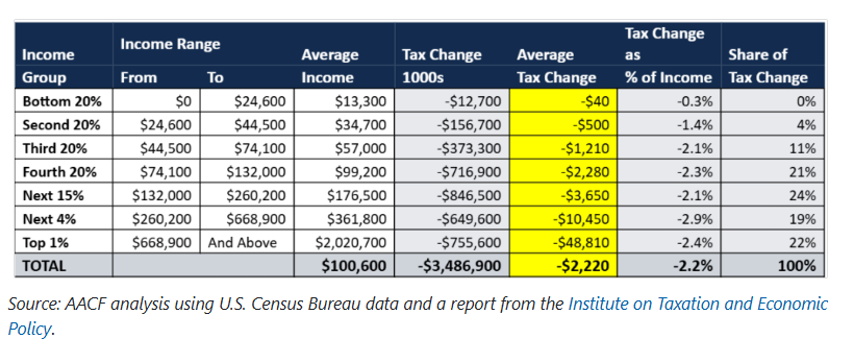
It’s also important to keep in mind that OBBBA only extends certain provisions of current income tax law, so people won’t see any kind of windfall from this next year. Any claim that the reconciliation bill benefits all Arkansans is an exaggeration at best. At the basic level, it hurts working families: lower income earners in Arkansas will see very little benefit from tax savings as they are hurt by cuts to Medicaid, SNAP, and other basic needs programs.