Introduction
What is the fiscal impact of the Education Freedom Account (EFA) program, the state’s K-12 school voucher program established by the LEARNS Act? This is one question the Department of Education Reform at the University of Arkansas, in collaboration with the Arkansas Department of Education (ADE), set out to answer in its latest Arkansas Educational Freedom Accounts Program Annual Report released in September 2025. As required by Arkansas law, the annual publication provides information on the state’s publicly funded homeschool and private school voucher program, including a preliminary analysis of the program’s fiscal impact.
The report covers the 2024-2025 school year, the second year of the voucher program, during which 14,526 students received EFAs. This is a jump from 5,546 participants in the 2023-2024 school year. Even with this increase, the report states that for the 2024-2025 school year, the program “remains fiscally modest relative to the state’s K-12 budget.”
However, Arkansas Advocates for Children and Families analyzed the report and offers that the fiscal impact of program is substantial given that school vouchers:
- Create significant new spending obligations, particularly considering that vouchers primarily support students who have never been enrolled in public schools
- Comprise a slightly larger portion of the overall K-12 budget than offered in the report
- Negatively impact public schools’ ability to cover ongoing, fixed costs
- Are already exceeding budget estimates, consistent with other states that have voucher programs
As the state gears up for both a fiscal session and the next educational adequacy review in 2026, it’s important to continue exploring these points and the impact of the K-12 school voucher program in Arkansas.
Switcher Savings Do Not Make Up for New State Spending on K-12 Vouchers
The voucher program for the 2024-2025 school year cost the state a total of $93.8 million. However, the report points out that students who would have otherwise enrolled in public schools but are now receiving a voucher — referred to as “switchers” — save the state money because the voucher amount is 90% of state per-pupil funding. Using that argument, the majority of switchers would save the state a minimum of $915 per student (certain students with disabilities who receive a voucher receive a higher voucher amount). However, public school districts receive additional “categorical” dollars for programs like 202English Language Learners, Alternative Learning Environments, and free or reduced lunch, depending on the number of students enrolled in those programs. The report notes that switchers would no longer require these funds and therefore save the state more than the minimum savings estimate of $915. When taking categorical spending into account, the report estimates that switchers created potential savings that range between $12.2 and $22 million in total, thereby reducing the school voucher program’s net cost to between $71.8 and $81.6 million. The report highlights the midpoint estimate of $17.1 million in savings — offsetting only 18.23%, or less than one-fifth, of total program expenses.
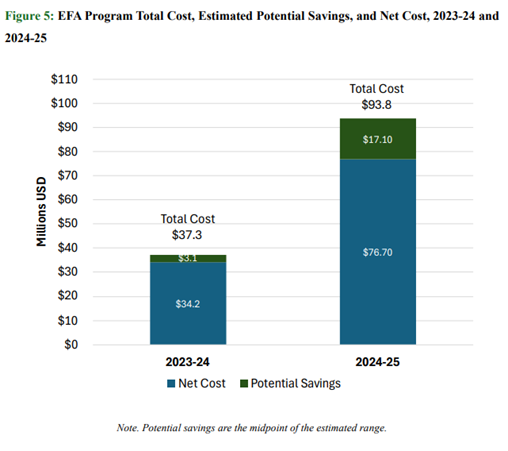
But during the 2024-2025 school year, only 12% of students came from public schools. In 2023-2024, 18% of voucher participants were previously enrolled in public schools. As such, across the first two years of the program, approximately 2,742 students switched from public schools to private schools or homeschooling, or around 19% of all voucher recipients. In other words, even if switchers theoretically save the state money, the vast majority of vouchers are supporting students who have never been enrolled in a public school, so the voucher program is still generating significant new state spending.
School Vouchers as a Component of the Overall K-12 Budget
The report also claims that the EFA program is fiscally modest because it serves a higher percentage of students than its share of the Division of Elementary and Secondary Education (DESE) budget. Specifically, in 2024-2025, the state spent 2.6% of its K-12 education budget to support 3% of students. The report cites the DESE budget as $3.5 billion, but some of the included line items in that budget are for early childhood education as well. For example, the budget includes $114 million for Arkansas Better Chance, the state-funded early childhood program, and $22.9 million for early childhood special education. When early childhood programs are removed from the equation, the 2024-2025 voucher budget represents 2.8% of the DESE budget, a small increase, but one that is important to acknowledge, nonetheless.
Finally, another interesting point about the fiscally modest argument predicated on “switcher savings” and the school voucher budget compared to the overall DESE budget: voucher advocates have long argued that EFA spending is entirely separate from public school funding and therefore should not be compared. The report now directly compares the two. At the end of the day, Arkansas taxpayers spent up to $81.6 million during the 2024-2025 school year to subsidize the education of students who — for the vast majority — had never previously attended public schools.
K-12 School Vouchers Affects Make It Harder for Public Schools to Manage Ongoing Operating Costs
In addition to increasing state spending, the school voucher program also bears a cost to public schools. While voucher proponents argue that “the voucher follows the student,” the cost of operating public schools remains unchanged even when those students leave. As a result, a financial burden is placed on the public schools these students leave behind. For example, if just one student in a class of 20 students switches from public to private school or homeschool with the support of a school voucher, the public school classroom will still be needed for the following school year. The teacher will have the same salary, the lights will stay on for the same amount of time, the costs of building maintenance and operations will stay steady, and the same number of support staff will be required. However, the classroom will generate 5% less per-pupil funding than the previous year. With this in mind, some advocates have proposed the frame that funding actually follows the classroom, rather than the student, to better explain how vouchers do, in fact, have a negative impact on public school budgets.
Current law does provide districts with declining enrollment funding (a fraction of the per-pupil funding they have lost); however, this funding is only available to schools for up to two years. It is not a permanent fix to declining per-pupil funding as the fixed costs of running a school continue.
Voucher Program Budgets in Arkansas and Across the Country Continue to Expand
Leaving the 2024-2025 report aside for a moment, what does the future hold for the school voucher program in Arkansas, budget-wise? Early estimates indicate that in this first year the program has been open to all students — resulting in more than 51,000 applications — associated costs for the 2025-2026 school year will reach approximately $358 million, exceeding the budgeted $277 million by 29%. With these estimates, it appears Arkansas is on course to see the school voucher costs continue to balloon astronomically beyond initial cost projections, similar to the pattern established by other states with universal voucher programs.
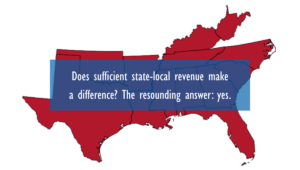
As of March 2025, 15 states have universal voucher programs as shown in the map below.
States With a Universal School Voucher Program
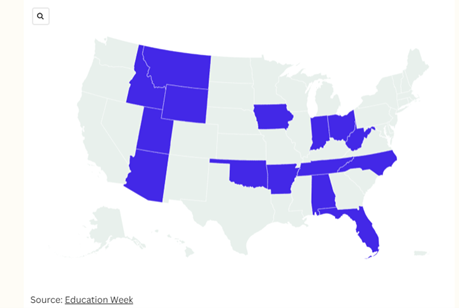
Other states with universal voucher programs have experienced fiscal strain due to the significant new spending obligations vouchers create. Arizona operates a voucher program similar to Arkansas’s: lawmakers budgeted $624 million for the 2023-2024 school year, but actual costs reached $940 million, meaning the program was more than 50% over budget. More than 70% of Arizona voucher recipients had never been enrolled in public schools, and public education funding was subsequently reduced by 5.7%.
In Ohio’s first year of universal eligibility, their voucher program was over budget by $34 million dollars. In 2025, Ohio approved a $403 million increase to the voucher program budget while simultaneously reducing the amount of funding for public schools.
Florida, like Arkansas, passed a universal voucher program in 2023. The program is already costing the state $398 million more than originally projected. Even before universal eligibility, Florida had a partial eligibility voucher program since 2001. Between 2008-2019, voucher spending increased 313% while public school funding declined by 12% over that same period.
The outcomes in these states should serve as a warning as Arkansas enters the 2026 fiscal session and the state begins the next adequacy process for funding public schools. Arkansas Advocates will closely monitor legislative decisions and advocate strongly for fully funded public schools.
Conclusion
The 2024-2025 Arkansas Education Freedom Accounts Program Annual Report does not demonstrate that Arkansas’s voucher program is fiscally modest. Evidence from the first two years shows that the program has created substantial new spending obligations, with costs already exceeding initial projections and only a small fraction of expenses offset by switchers. The overwhelming majority of EFA recipients were never enrolled in public schools, meaning the program largely subsidizes private education for those who already had the ability to choose which school to attend. Outcomes from other universal voucher states further illustrate the long-term budgetary risk this program poses, including escalating costs and reductions in public school funding. As Arkansas begins to determine adequate and equitable funding for public education amid a challenging economic environment, policymakers must carefully weigh the growing financial burden the school voucher program creates.