
As we draw to the end of National Kinship Care Month this September, we continue to honor the grandparents, other relatives, and close family friends who step up to raise children whose parents cannot. Importantly, this National Kinship Care Month celebration includes relatives and family friends who care for children regardless of whether the state child welfare agency is involved. However, in this blog we’d like to focus on the Arkansas Department of Human Services (DHS), Division of Children and Families’ (DCFS or Division) efforts around placement with relatives and “fictive kin” (i.e., those who are not related by blood, marriage, or adoption but have a strong, positive, and emotional tie or role in the child’s life). These placements are often collectively referred to as kinship placements or kinship foster homes and have served as one key to improving outcomes for children who must enter foster care.
According to the DCFS Practice Model, the agency’s top priority is to safely stabilize and preserve families; and, if that is not possible, then the next priority is to place children who have been removed from their home with a relative or fictive kin. Placement in a safe and appropriate kinship foster home is always the first goal when a child is removed because it reduces the trauma a child experiences when entering foster care if they can immediately be placed with someone they already know, love, and trust.
A child can be placed quickly with a relative or fictive kin because a kinship home can be opened on a “provisional” basis after background checks are received and a visual inspection of the home is completed — all of which can take place in a matter of hours. The kinship home then has six months to come into compliance with all other traditional foster home requirements, with some exceptions. State general revenue (SGR) funds the board payment — a monthly payment to the foster parents to help defray the cost of caring for a child placed in the home — while the kinship home is on provisional status. Once the home becomes fully approved, federal dollars pay for the majority of the monthly board payment.
Recent data show that DCFS has worked steadily to ensure kinship foster placements are not just a priority on paper but are also the practice. At the end of August 2025, 41.3% of children in foster care were placed in a kinship placement. Kinship placements statewide have averaged at just over 39% for the last year, exceeding the national average of 35%. This consistency prompted the Division in April of this year to adjust its long-standing goal of 40% of children placed with relatives and fictive kin statewide to a goal of 50%.
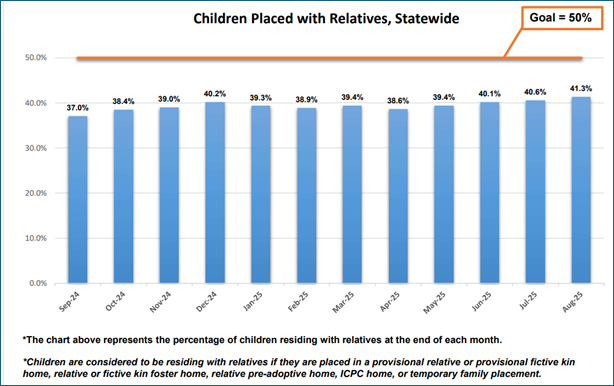
Arkansas Division of Children and Family Services, “Every Day Counts- August 2025.”
This consistency and willingness to improve are cause for celebration enough, but even more so considering that almost 10 years ago, kinship placements only comprised an average of 22% of all foster care placements. In 2016 the Division began making concerted efforts to safely improve kinship placement rates in Arkansas. Over the years these efforts included processing background checks more quickly, requiring staff responsible for opening foster homes to be on call, reducing the training hours for kinship foster parents, investing state general revenue to provide financial support to kinship foster parents until they can qualify for board payments funded by federal dollars, and waiving certain “non-safety-related” licensing standards, as allowed by the federal Fostering Connections to Success and Increasing Adoptions Act of 2008 (prior to this Act, kinship homes had to meet the exact same licensing standards as traditional foster homes). For example, minimum licensing standards in Arkansas require a foster home to ensure a child’s bedroom is at least 50 square feet. However, if the bedroom in a kinship foster home is only 40 square feet, the agency could waive that requirement as a non-safety-related standard to help facilitate that placement.
This work has paid off. Consistent with national statistics, Arkansas data demonstrates that children whose first placement is with a relative have better outcomes than children who are placed in a traditional foster home. Traditional foster homes are still a vital component of the child welfare system for those children who do not have a relative or fictive kin placement option. However, when a safe and appropriate kinship home is available, the data are clear that kinship family should be the preferred placement.
For example, children whose first placement is with a relative or fictive kin have fewer placement moves during their time in foster care than children whose first placement is in a traditional foster home. It is critical to ensure placement stability because any placement change can be another form of trauma for a child. Placement changes result in poorer educational outcomes (with children often changing schools with each placement move), difficulty in forming healthy attachments to caring adults, and delays to permanency. For calendar year 2023, Arkansas children whose first placement was with a relative averaged 2.53 moves per 1,000 days in foster care, much better the national placement stability standard of 4.12. However, children who were first placed in a non-kinship home had an average of 6.92 placement moves in calendar year 2023. What’s more, the higher degree of placement stability for children whose first placement is in a kinship home has been a consistent trend in our state over the last several years as shown in the table below.
| Placement Stability Rate Among Children Entering Foster Care in Arkansas | ||||
| Number of Moves Per 1,000 Days in Care | ||||
| Period | First Placement with Relatives | First Placement with Non-Relative | Total | National Standard |
| 1/1/2018 – 12/31/2018 | 2.60 | 6.43 | 5.96 | 4.12 or Less |
| 1/1/2019 – 12/31/2019 | 2.58 | 7.34 | 6.32 | |
| 1/1/2020 – 12/31/2020 | 2.52 | 6.70 | 5.66 | |
| 1/1/2021 – 12/31/2021 | 2.74 | 6.80 | 5.25 | |
| 1/1/2021 – 12/31/2022 | 3.17 | 6.87 | 5.43 | |
| 1/1/2023 – 12/31/2023 | 2.53 | 6.92 | 5.28 | |
Arkansas Division of Children and Family Services, Children’s Reporting Information System (CHRIS) data
Data also show that children whose first placement is with a relative or fictive kin achieve permanency more quickly, meaning they leave foster care because they either reunify with a parent, enter into a legal guardianship or custody arrangement, or are adopted. In calendar year 2022, 45.7% of children whose first placement was with a relative achieved permanency within 12 months of entering foster care, exceeding the national standard of 40.5%. Meanwhile, only 36.9% of children whose first placement was with a non-relative achieved permanency in that same timeframe. Foster care is necessary in some circumstances to ensure the safety of children, but it is designed to be temporary. As a result, strategies that ensure a child swiftly and safely exits foster care — such as a safe and appropriate kinship placement — should be prioritized.
| Percentage (%) of Children Entering Care who Achieved Permanency within 12 Months of Entry in Arkansas | ||||
| Period | First Placement with Relatives | First Placement with Non-Relative | Total | National Standard |
| 1/1/2017 – 12/31/2017 | 61.6 | 51.9 | 52.7 | 40.5% or More |
| 1/1/2018 – 12/31/2018 | 58.8 | 49.5 | 49.6 | |
| 1/1/2019-12/31/2019 | 46.0 | 44.9 | 45.1 | |
| 1/1/2020 – 12/31/2020 | 45.8 | 37.7 | 40.3 | |
| 1/1/2021 – 12/31/2021 | 47.3 | 35.4 | 39.7 | |
| 1/1/2022 – 12/31/2022 | 45.7 | 36.9 | 39.9 | |
Arkansas Division of Children and Family Services, Children’s Reporting Information System (CHRIS) data
With the data bearing out that safe and appropriate kinship foster homes produce better outcomes, how can DCFS achieve its goal of ensuring that 50% of children in foster care statewide are placed with a relative or fictive kin? One option: adopt kinship-specific licensing standards.
In September 2023, the federal Administration for Children and Families (ACF) issued a final rule that allows title IV-E agencies (typically the state’s child welfare agency) to develop separate licensing standards for kinship caregivers given the overwhelming research concluding that children often do better when placed with relatives and fictive kin. The federal rule only requires that title IV-E agencies’ kinship-specific licensing standards align with “recommended standards for national organizations for foster family homes related to admission policies, safety, sanitation, protection of civil rights, and use of reasonable and prudent parenting standards” and that caregivers meet federal requirements related to background checks. This gives child welfare agencies an enormous opportunity to remove many bureaucratic barriers to licensing.
For instance, while the previously mentioned waivers for non-safety-related standards are still an option, they require varying levels of approval and effort depending on the particular standard being considered for a waiver. Some standards may be waived by leadership at the local level while others must be approved by state-level administration and still others must go — along with paperwork documenting the issue and justification for the waiver — before the Child Welfare Agency Review Board for consideration. Implementing kinship-specific standards would streamline this process thereby reducing the burden for kinship families and DCFS staff. It would also save the state money: Recall that when a kinship home moves from provisional status to fully approved status, the state pulls down federal funds for the monthly board payment, rather than using 100% state general revenue for that cost.
When the final federal rule was announced in 2023, DCFS showed interest in developing kinship-specific licensing standards for Arkansas. The Division discussed its intent to draft the standards with the Child Welfare Agency Review Board, and a workgroup comprised of DCFS staff, DHS Placement and Residential Licensing Unit employees, private foster home providers, current kinship foster parents, and other stakeholders collaborated over several months to develop the kinship-specific licensing standards and produced a final draft, but the formal promulgation (rulemaking) process, which is coordinated by a different office within DHS, has not yet started.
Twelve other states, including Tennessee and Louisiana, have taken the kinship-specific licensing standards option. Three other states, including Oklahoma, have submitted their kinship-specific standards to ACF for approval. To continue increasing kinship placement rates in our state, which the data clearly show is one way to better support children in foster care, a logical next step would be to implement kinship-specific licensing standards. The state has made an immense amount of progress, especially around ensuring supportive foster care placements. Let’s keep that progress going by adopting kinship-specific licensing standards.