

While we have frequently highlighted how the One Big Beautiful Bill Act slashes funding for health care and food assistance, another provision of the One Big Beautiful Bill Act stands to harm public education: the creation of the federal school voucher program. The new program provides a federal tax incentive to generate additional money for private school education and other educational expenses. The tax incentive is money that would have otherwise been owed to the government through taxes. This is money that, with Congress’s direction, the federal government could have spent on something else, like investing in programs that lift children and families out of poverty or in public education.
What is the federal school voucher program?
The federal program is a tax-credit scholarship set to take effect on January 1, 2027, and states will have to choose whether they want to participate. For states that opt-in, individual taxpayers can claim a tax credit for contributions they make toward a scholarship granting organization (SGO) that will then hand out tuition vouchers to attend private schools. A tax credit is an amount that reduces a taxpayer’s tax liability. This new tax credit will allow 100% reimbursement of what the taxpayer spent, up to $1700, which is a generous provision not seen in any other part of the tax code. Typical tax credits you’ve heard of before to encourage charitable giving to worthwhile causes, like children’s hospitals or veterans’ groups, do not rise near this level of reimbursement. Tax credits are usually set at a 35% reimbursement rate.
Who can receive federal school vouchers?
A K-12 student whose household income is up to 300% of the area’s median income is eligible. In Arkansas, area median income ranges from $48,300 in Desha County to $101,800 in Northwest Arkansas, so eligibility in our state would be household incomes that range from $144,900 to $305,400 and are based on where a student’s family lives.
What can federal school voucher funds be spent on?
Eligible elementary and secondary educational expenses, which are defined in another part of tax law, qualify as eligible expenses for the federal school funds. They include private school tuition and fees and other educational costs associated with private, public, or religious schools.
New Federal Voucher Program
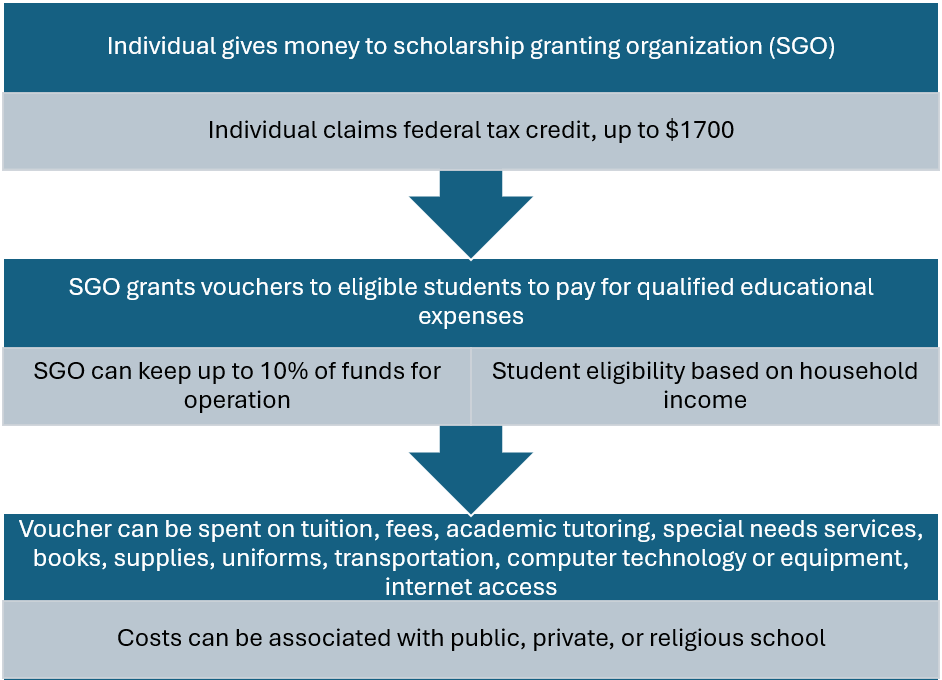
Since Arkansas already has state-level universal vouchers established through the LEARNS Act, are there ways to utilize this new federal option for other students?
Yes, Arkansas could still opt-in. Much of the flexibility that states will have to implement their own programs will depend on the rules developed by the U.S. Department of the Treasury. If the rules allow states the flexibility to design their own programs based on local need, our state could use this federal tax credit for kids and communities who need more support rather than allowing it to serve as another method to subsidize private education. For example, Arkansas could limit the new federal school vouchers to educational costs for students attending public schools, like tutoring, special needs services, after school programs, or transportation or enrollment costs for specialized classes not available in a student’s own school.
What is next?
The next step is for the federal government to create rules to implement this new type of tax credit, including a rule on how much leeway states will have to craft their own programs, and states that choose to participate will need to develop their own processes and rules on how to structure the program in their state.
What should Arkansas do?
There are factors for Arkansas to consider. First, we already have a state program that mirrors the federal school voucher program: the Philanthropic Investment in Arkansas Kids (PIAK). Act 904 of 2021 established PIAK two years before our newest voucher program passed in the LEARNS Act. It may be helpful to explore its differences with the new federal program, as outlined in the table below.
| PIAK | Federal Voucher Program | |
|---|---|---|
| State/Federal tax credit | State | Federal |
| Who can claim | Individual or business | Individual |
| Percentage of Contribution | 100% | 100% |
| Maximum Credit | None | $1700 per individual (subtract contributions claimed as a state credit) |
| Annual Cap Based on Budget | $6,000,000 per calendar year | No cap |
| Student Eligibility | Up to 200% of federal poverty level | Up to 300% of area median income |
| Eligible Expenses | Private school tuition and fees | Educational costs associated with private, public, or religious school |
Second, Arkansas is facing a lot of decisions about our state budget and how to care for Arkansans, particularly in light of a decade of state tax cuts. For example, state leaders must determine how to respond to the ballooning costs of our own universal voucher program as well as to provisions of the One Big Beautiful Bill Act that will shift costs from the federal government to the state if programs like the Supplemental Nutrition Assistance Program (SNAP) are to continue operating at their current capacity. Instead of adding another voucher program to our landscape to increase further spending on private education, it would be prudent to incentivize spending toward other needs in our state, such as robust tax credits to increase access to quality child care options.
If the state does proceed to opt into the new federal school voucher program, I ask for creativity for a narrowly tailored program to mitigate further harm to public education and to support students who need help the most. For example, designate the money for high impact tutoring for public schools — expanding the grant program that started under LEARNS — or increase access to quality after-school programs in communities that need more resources and supports. Creating yet another private school voucher program will hurt public schools even more. Let’s think outside the box to help Arkansas students thrive.