
What’s in a Rule?
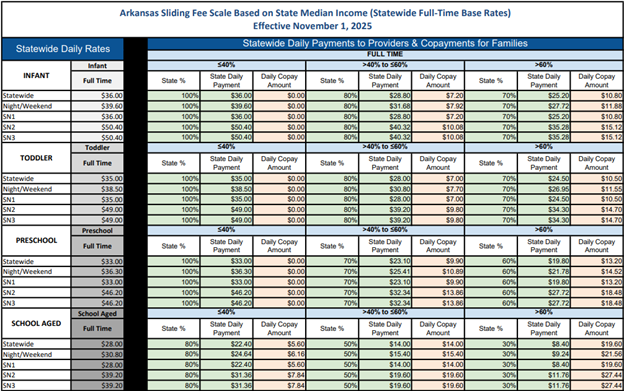
There has been a rollercoaster of changes to the state’s School Readiness Assistance (SRA) program, which is also known as the child care voucher program, over the last two months. There are many areas worth diving into, but let’s focus on the children and families the program is meant to serve and discuss the new family copayment structure.
Access to safe and high-quality child care is critical for families. The purpose of the SRA program is to help provide child care for working families who need additional financial support to make ends meet. Eligible families either work, attend school, or participate in a job training program.
The SRA program in Arkansas is mostly funded from federal money, known as the Child Care and Development Fund (CCDF), in addition to the state putting up some matching funds. There are federal requirements located in regulations that describe the responsibilities the state has and the different rules it must follow in order to receive CCDF dollars. The state has the ability to request permission from the federal government to temporarily cease compliance with federal regulations through a formal process called a waiver request. See 45 CFR § 98.19. We explore some of these federal regulations below.
Cannot Charge Families More than 7% of Household Income
The federal program updated many of its requirements through the 2024 CCDF Final Rule in an effort to help working families afford child care and increase access to quality child care settings. Specifically, the rules prohibit states from charging family co-payments above 7% of a family’s income. This had been a recommendation for the U.S. Department of Health and Human Services since 2016 but is now a CCDF program requirement. The federal law also requires co-payment policies that are not a barrier to families. This is good policy.
As described in the rule’s executive summary, unaffordable copayments “can limit family participation in the CCDF program, cause parents to cut work hours or exit the workforce entirely, and may lead families to patch together informal, unregulated care that is less expensive, less reliable, and less likely to meet children’s developmental needs.”
Prior to October 1, 2025, Arkansas complied with this rule. The new copayment structure now in effect violates this rule, though the state requested a waiver on September 25, 2025, to be held harmless from the violation. That waiver request was approved by the federal Administration for Children and Families on November 28, 2025. The Early Childhood Commission Emergency Working Group formed in October recommended a cap on family copayments of no more than 7% for families with multiple children. This recommendation was also adopted by the Arkansas Early Childhood Commission and is currently being analyzed for financial feasibility by the Office of Early Childhood at the Arkansas Department of Education.
Cannot Increase Copayments Except at Family’s Re-Certification
The rules governing the CCDF program also prohibit a state from increasing family copayment amounts within the 12-month eligibility period, except for special circumstances that don’t apply here. See 45 CFR § 98.21(a)(3), (b). When families apply and get approved for the program, the 12-month eligibility period starts, as described in the federal rule. Recertifications in Arkansas typically occurred between 13-24 months after the initial certification, depending on what quality level program the family chose. Recertifications will now occur every 13 months for all families.
Instead of the new copayment structure being implemented according to the federal rule, which would prevent an increase in the family’s copayment until the recertification date, the copayment scale became effective on October 1, 2025, for all participating families. The sliding scale was updated, effective November 1, 2025, but that did not link the new scale to a family’s recertification date.
Cannot Base Sliding Fee Scale on Cost of Care or Amount of Subsidy Payment
The federal rule also states the sliding fee scale for families can be based on income, the size of the family, and other factors as appropriate, but may not be based on the cost of care or the amount of the subsidy payment. See 45 CFR § 98.45(l)(2). The Arkansas plan does exactly that: links the copayment amount to a percentage of the subsidy payment, or base rate. While the new copayment structure does take a household’s income and family size into account when determining the amount a particular family owes, the formula is no longer linked to the quality rating of the facility a child attends as it has done in the past.
If the very rules meant to keep child care affordable for families and maintain working parents’ access to quality child care programs for their kids no longer apply, then we need to ask ourselves, what comes next? Families and children are being impacted, and it’s exactly in the ways warned about, like parents reducing work hours and not having safe childcare solutions for their families. Family stories deserve to be uplifted during this time. Only when we listen to what families really need and are going through will we learn what needs to come next.