The Supplemental Nutrition Assistance Program (SNAP, formerly known as Food Stamps) has been featured heavily in recent headlines as the availability of November SNAP benefits — either in whole, in part, or not at all — has been in question amid the 43-day federal shutdown. The shutdown has now officially ended, and DHS reports that full November SNAP benefits should be issued by midnight tonight.
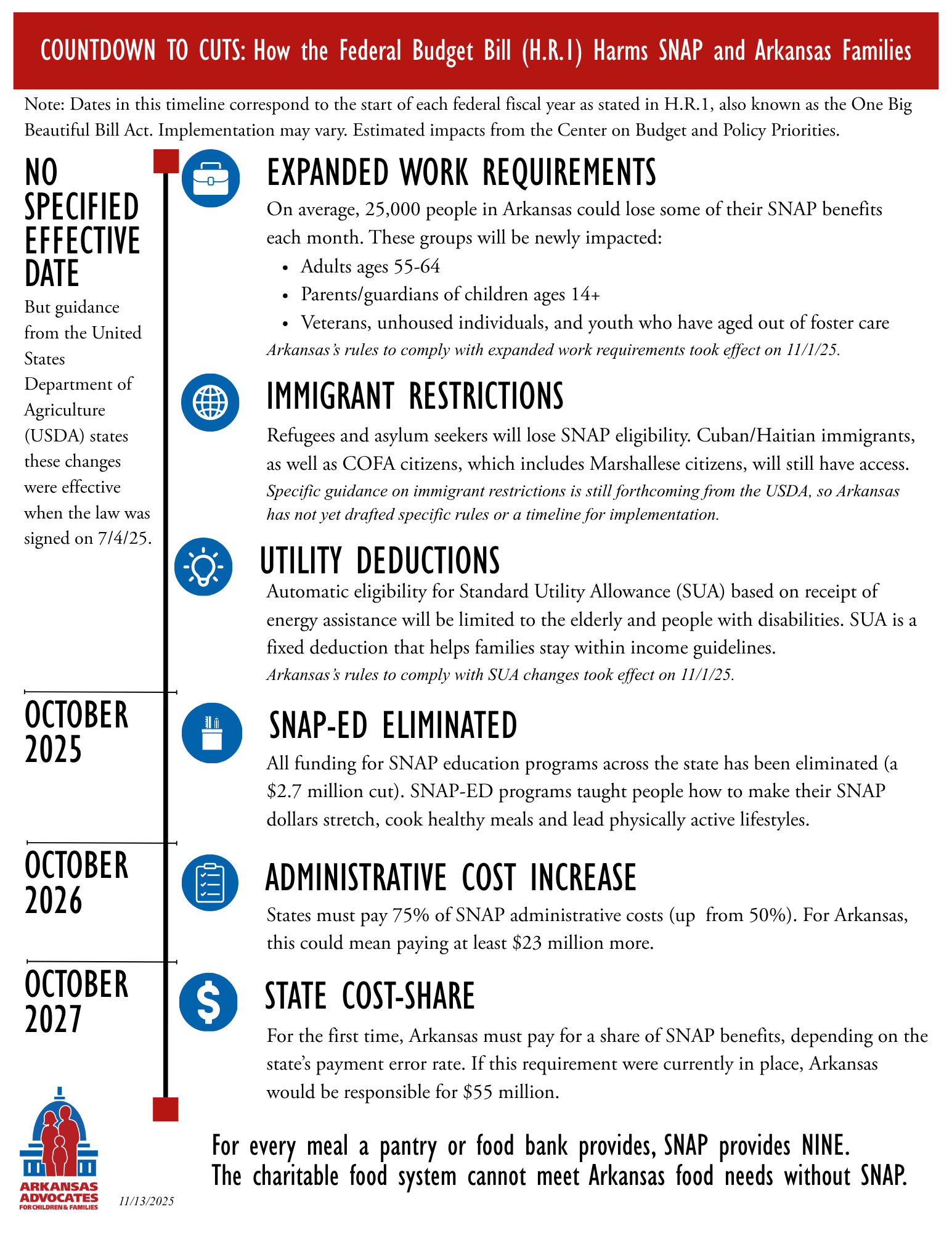
However, amid the chaos of court orders, appeals, and conflicting guidance to state agencies from the United States Department of Agriculture regarding the November SNAP benefits, many may have missed another important change to SNAP that occurred on November 1: the implementation of new work requirements and revisions to automatic eligibility for the Standard Utility Allowance for certain populations. These changes are the latest cuts that have taken effect as a result of the “One Big Beautiful Bill Act,” or H.R.1, signed into law on July 4. The policies will soon take a toll on many families in our state who already struggle with food insecurity. We dive into the specifics below.
Work Requirement Changes
Before November 1, adults ages 18 through 54 who met the income and asset limit requirements for SNAP had to also spend at least 80 hours per month working, volunteering or participating in an employment or training program to receive SNAP benefits, if they were considered physically and mentally able to participate in these activities. Work requirement exemptions included adults who had responsibility for a child under the age of 18 living in their home, veterans, youth ages 24 and younger who had aged out of foster care, and unhoused individuals. For adults who did not meet the work requirements or qualify for an exemption, the time limit rules would then be applied: SNAP benefits for only three months every three years. This is sometimes called the Able-Bodied Adult Without Dependents (ABAWD) work requirement or the requirement to work.
But because of H.R.1, the requirement to work now also applies to adults ages 55 through 64 as well as parents whose children living in the home are 14 years of age or older. In addition, previous exemptions from the requirement to work for veterans, youth aging out of foster care, and unhoused individuals no longer exist. As such, our neighbors in these categories who otherwise qualify for SNAP will generally only have access to critical food assistance for three months every three years, unless they meet another approved exemption. And for adults in these groups who were previously receiving SNAP benefits, the three-month time limit clock began ticking on November 1. Consequently, we estimate that approximately 25,000 Arkansans will lose access to SNAP benefits over the next several months. This is a significant loss considering that Arkansas is already the most food insecure state in the country.
Standard Utility Allowance
The Standard Utility Allowance (SUA) is a fixed deduction that helps low-income families stay within the restrictive SNAP income requirements. It provides an alternative to beneficiaries reporting actual monthly energy expenditures, which simplifies the benefit determinations process and ensures equitable assistance levels. Prior to November 1, if a family received more than $20 in energy assistance, such as Low-Income Home Energy Assistance Program benefits, they automatically qualified for the SUA deduction. The current SUA deduction in Arkansas is $342 — not an insignificant amount when trying to stay within narrow SNAP income rules.
But effective November 1, H.R. 1 limits automatic eligibility for the SUA deduction based on receipt of energy assistance to seniors and individuals with disabilities. Other adults are still eligible for the SUA deduction. However, they must now provide documentation demonstrating that their energy costs exceed the energy assistance benefit amount to qualify for the SUA deduction.
This means more hoops for families to jump through. In turn, some families may lose out on SNAP benefits all together because, without the SUA deduction, they may be over the income limit yet still struggling to make ends meet given the restrictive income SNAP limits and soaring grocery prices.
Conclusion
The news of the reinstatement of full SNAP benefits for the month of November is something to celebrate. At the same time, be aware that access to SNAP will be curtailed over the next few months for many Arkansans because, while the federal government shutdown is over, the impact of H.R.1 has just begun. The progression of the H.R. 1 cuts to SNAP is summarized in the graphic below. These cuts will not only hurt low-income families who are trying to put food on the table but also our local communities. Every SNAP dollar spent generates up to $1.80 in economic activity. As a result, as SNAP purchases decrease, local economies also shrink, and grocery prices continue to rise for everyone to make up for SNAP losses. SNAP cuts are happening. And eventually we will all feel the consequences.