
“Affordability” has recently leapt into the national political consciousness with a vengeance. Of course, affordability is not a new challenge for Arkansas families that sit down at the kitchen table and make hard choices about expenses, especially during the holidays. In our state, 537,100 households (44%) struggle to afford basic household expenses.
A lot of affordability challenges are caused by inflation. For a family, inflation is the decrease in spending power given the same amount of salary or other financial resources. The U.S. Bureau of Labor Statistics is responsible for measuring inflation each month through the Consumer Price Index. And while the Bureau doesn’t present data at the state level, it does for four regions, including the South. In our region, inflation peaked at nearly 9% in 2022 and has been coming down since. But 2024 ended with 3% inflation, and 2025 is similar so far; inflation in September 2025 — the latest data we have — is up 2.7% compared to September 2024.
Arkansas families may find some prices are lower, some are higher, but on average, across all goods (including food, housing, fuel, utilities, transportation, medical care, and education) prices are up. Think of it this way: every dollar earned is worth only about 97 cents compared to last year. And that dollar is only worth about 77 cents compared to just five years ago.
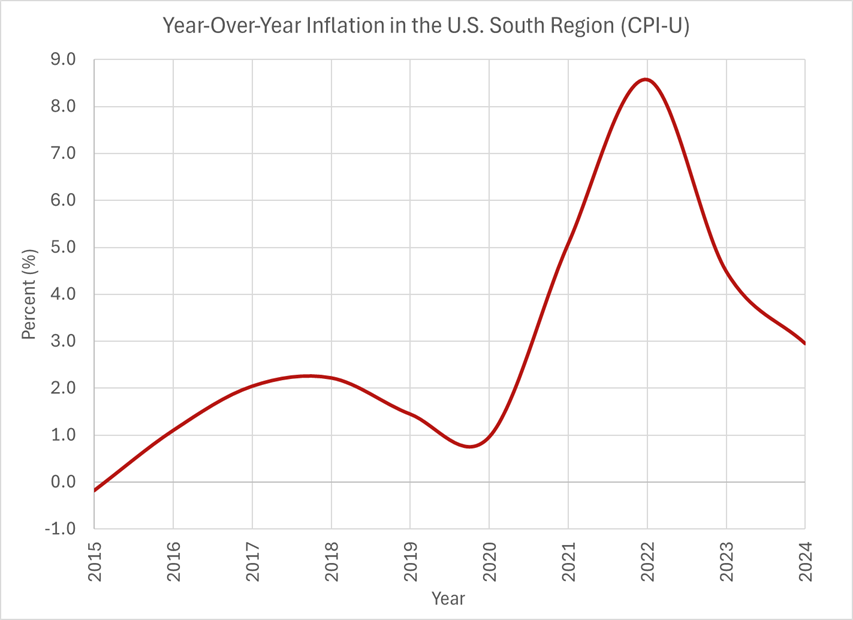
Source: U.S. Bureau of Labor Statistics.
Inflation — and how much things cost — is only half of the equation, however. Just as important to affordability are wages or salaries, and how much they have or have not increased.
Passing a new minimum wage in 2018 was a triumph for Arkansas voters and workers. When the minimum wage rate reached $11 an hour in 2021, it was enough to lift a family of three out of poverty. But now it barely moves a family of two beyond the federal poverty level. And soon it won’t be enough to do even that. This is because the official Federal Poverty Level is adjusted for inflation (because those things a family needs become more expensive). At the same time, the minimum wage doesn’t change.
Federal Poverty Level for Family of Two (by Year)
| (Note: the Arkansas $11 minimum wage results in an annual salary of $22,880) | |
| Year | Dollars Per Year |
| 2021 | $17,420 |
| 2022 | $18,310 |
| 2023 | $19,720 |
| 2024 | $20,440 |
| 2025 | $21,150 |
| 2026 (estimated) | $21,780 |
Source: U.S. Department of Health and Human Services.
Think of a single parent and a child. And imagine trying to balance the budget on less than $23,000 a year.
Beyond the minimum wage, there is additional evidence that wages are not keeping up. Since World War II, productivity has rapidly increased in the United States. This means that American — and Arkansan — workers are creating more value for every hour worked. All of us are working harder. But at the same time, compensation for that work has only modestly increased. This widening gap is carried by workers and their families. The workers who have made the American economy strong.
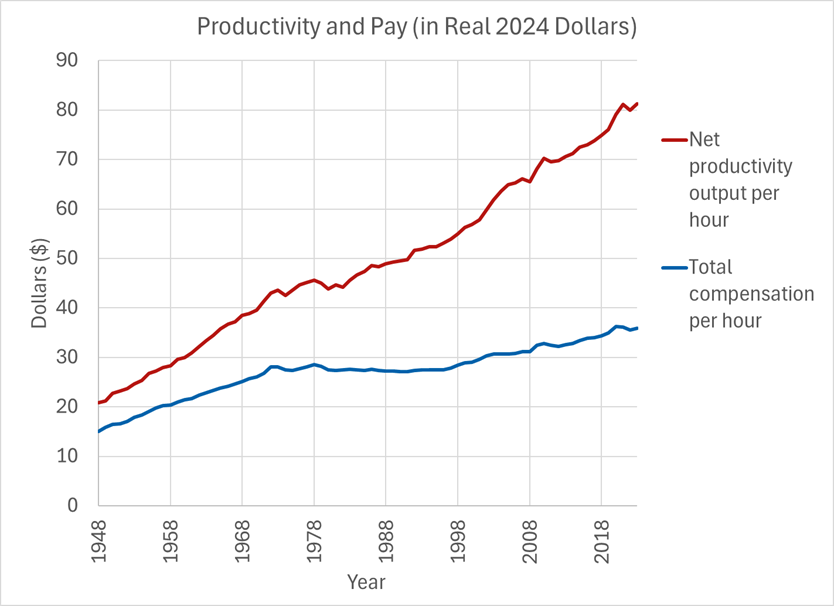
Source: U.S. Bureau of Economic Analysis, U.S. Bureau of Labor Statistics.
To be fair, Arkansas policymakers, including the governor and legislators, have little to no control over inflation in our country or state. Our national policymakers and the Federal Reserve Bank find it difficult to manage the rate of inflation. However, our state officials do have influence on the wage side of the affordability equation. They could, for example, institute a new minimum wage that lifts more families out of poverty and allows them to afford basic needs. Indeed, 26 states and the District of Columbia have minimum wage levels above that of Arkansas. Our state leaders could also “index” our minimum wage rate to inflation, so that it increases as the costs of goods and services increase.
But this isn’t just about the minimum wage. Arkansas laws and policies can support Arkansas workers in other ways as well. For example, the state could work to make child care and housing more affordable. It could institute paid family and medical leave to support workers and the people they care for. Policymakers could continue to improve maternal and infant health and provide free lunches in public schools. The state could launch a state-level child tax credit to help Arkansas children succeed. And officials could implement an economic development strategy that prioritizes Arkansas workers.
The Arkansas family budget and the state of Arkansas budget are linked. Investment by the latter makes good economic and common sense. And the return on the investment is a healthy, prosperous state for all Arkansans.