
Arkansas’s Education Ranking Unchanged, With Work to Be Done
As a continuation of our KIDS COUNT Data Book series, next we explore how Arkansas fared in educational outcomes. The education indicators capture what children and youth need most to promote educational achievement. There are four education indicators that are calculated and tracked each year and allow comparisons among other states, against the national average, and with prior years in Arkansas. These indicators are listed in the figure below.
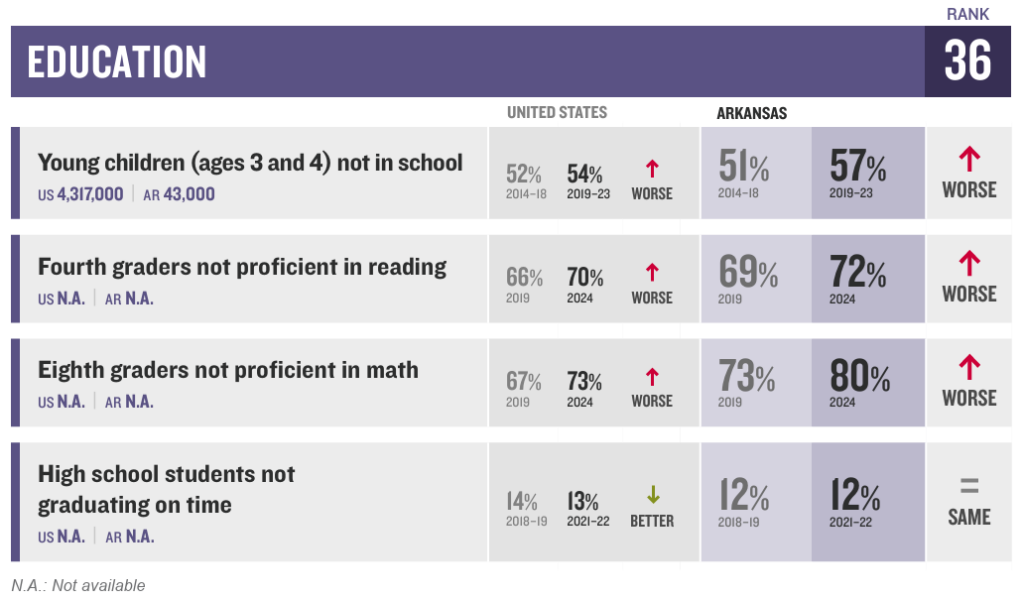
Our state ranking at 36th in education remained the same as last year, but three out of our four indicators are worse than the pre-pandemic ratings. One question is whether different provisions of the LEARNS Act passed in 2023 will positively impact our Data Book educational outcomes in the future. The Data Book indicators contain data from 2022-2024, most of which occurred before the LEARNS Act was passed or implemented. New requirements that could impact these educational outcomes in the future include:
- Assessing kindergarten through third grade students with a high-quality literacy screener to determine who needs targeted intervention and to track progression
- Offering tutoring grants to eligible students as well as school districts
- Requiring student success plans to guide a student through graduation and include any interventions needed to address academic deficits
- Providing trained literacy coaches to schools with a D or F rating
- Creating a new locally led system for early childhood education in which local organizations identify gaps in services and create alignment with providers in their communities
We know high-quality early education programs for 3- and 4-year-olds are pivotal resources for young learners’ development and well-being, especially for kids from low-income households. Access and participation in these programs, such as Head Start, also directly impact kindergarten readiness. Whether families have access to high-quality options in their community involves many factors, including cost and supply. Unfortunately, child care and early learning often cost more than other household expenses, such as housing. In Arkansas, the annual price of care for an infant and a 4-year-old is $17,498, compared to an average cost of $15,564 for housing.
The next two indicators involve assessment results from the National Assessment of Educational Progress (NAEP), in which a sample of students in each state take tests that then provide comparative data among states. This information is also compiled to create the Nation’s Report Card. National scores in 2024 were below pre-pandemic levels in all tested grades and subjects, so Arkansas is not an outlier in that regard. The 4th graders who took the reading test were in kindergarten in March 2020, when the pandemic hit. Similarly, 8th graders who took the math assessment in 2024 were in 4th grade in March 2020.
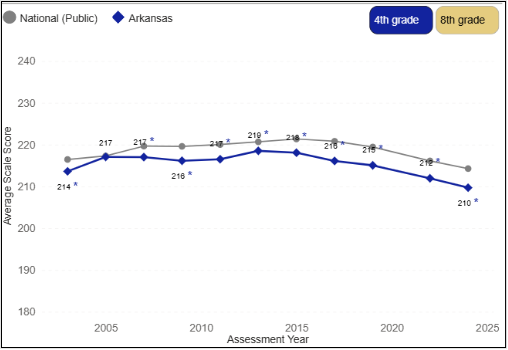
The results of the assessment are categorized as basic, proficient, and advanced achievement levels. The percentage of students in Arkansas meeting the basic achievement level in 4th grade reading has decreased since 2015, and the state’s overall reading score in 4th grade has decreased in the last decade, as shown on the line graph above comparing Arkansas and the national average score. No state made gains in reading in 2024.
Through the LEARNS Act, there are three new literacy resources that could positively impact scores going forward:
- Beginning with the 2023-2024 school year, literacy tutoring grants were made available for eligible K-3 students whose parents could then request the grant and pay for literacy tutoring services. Due to a recent law passed in 2025, the amount of the literacy grant is increasing from $500 to $1,500 during the upcoming school year.
- A new tutoring pilot program was also implemented during the 2023-2024 school year and has been renewed each year since, with $20 million available during the prior school year. The High-Impact Tutoring Pilot Program offers competitive grant funding for public school districts and open-enrollment public charter schools. High-impact tutoring is provided to students in small groups or one-on-one for a minimum of three times per week and is provided by a consistent tutor.
- Trained literacy coaches with expertise in pedagogy and the science of reading are provided for eligible schools.
Resources and a commitment to young learners’ literacy are especially important with another facet of the LEARNS Act, which requires students in 3rd grade to be held back if they have not met the 3rd grade reading standard by the end of the school year. The State Board of Education is set to develop rules for how this will be implemented, and students entering 3rd grade in the upcoming 2025-2026 school year are the first cohort to which the new rules will apply.
The results of our 8th grade students’ math assessment in 2024 were not statistically different than the previously tested cohort; however, the scores were significantly lower than 2019 scores, again modeling what was seen nationally and indicating lasting impacts from the pandemic. The percentage of students scoring below the basic achievement level has gone up in the last decade, revealing more and more students are falling behind.
The percentage of high school students not graduating on time remained the same, and Arkansas fared better than the national average. Of note, 44% of 4th grade students and 45% of 8th graders scored below basic in reading on the NAEP test. With close to half of students struggling in literacy, it is surprising to see such a high graduation rate. There were also disparities among districts in graduation rate, from a low of 69.23% to greater than 98%.
The education indicators and data tell a story, and the question we are left with is: What will change going forward to improve opportunities for students in our state? Or perhaps a better question is: Who? The new school year is right around the corner, and our Congressional delegation returns to D.C. in September to work on appropriations. Arkansas policymakers need to demonstrate the same level of commitment to students that our teachers and other school staff show to students each day. Our Congressional delegation can do this by committing to financial investments and policy changes that will catapult Arkansas from ranking 36th in education toward the top.