

Most Arkansas students recently wrapped up their school year. Their end-of-the-year ATLAS test results mean more for some than for others. Third graders who do not meet the state’s reading standard by scoring a Level 2 or higher on the English Language Arts (ELA) portion of the exam or fall into a good cause exemption will not join their classmates in the fourth grade. This requirement does not apply to homeschool, microschool, or private school students. An outline of all good cause exemptions for Arkansas third graders in public schools is provided below.
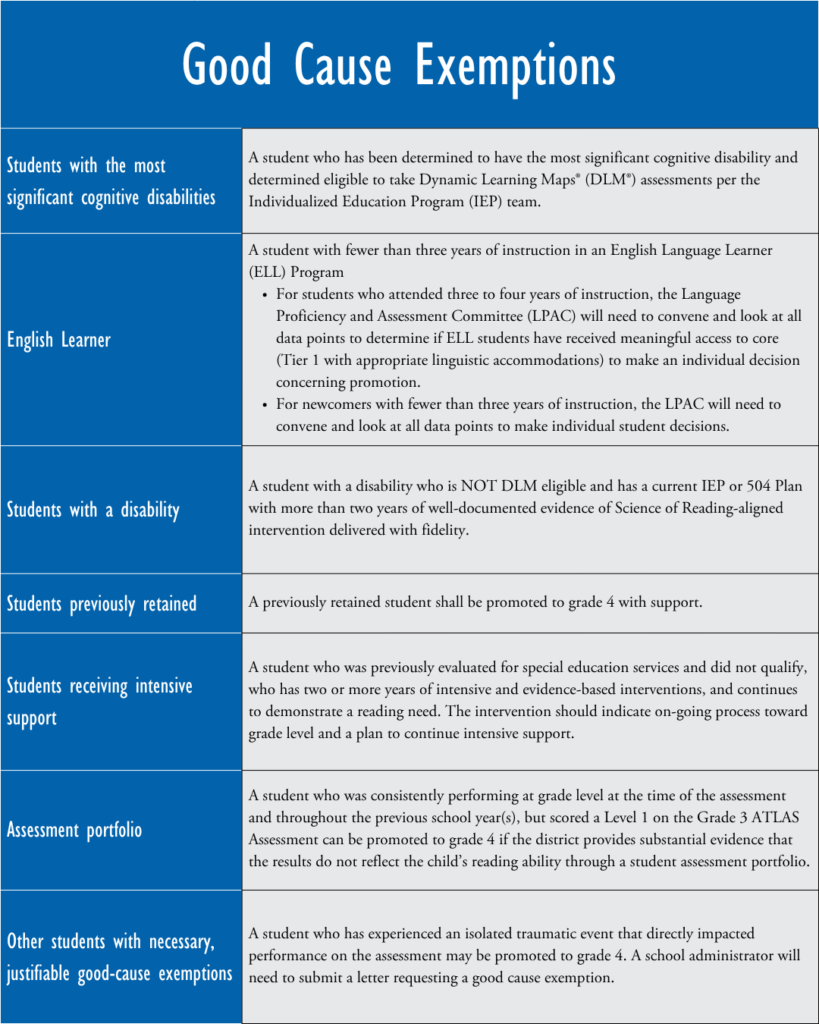
Third grade retention based on literacy, modeled after Mississippi’s law, was included in LEARNS, the K-12 education omnibus bill passed in 2023. Based on last year’s test results, nearly two-thirds of Arkansas students finished third grade without being able to read proficiently. Reading proficiency is indicated by scoring a Level 3 for proficient or 4 for advanced on the ATLAS ELA assessment. Literacy laws in Arkansas have molded and grown in the last decade, with additional supports being incrementally rolled out to students. State policies continue to promote K-3 screening, early identification of reading difficulty and early supports, including individual reading plans with intensive and evidence-based literacy interventions for each student in K-3 who doesn’t meet the reading standard. However, only when a student is held back or promoted under an exemption under this LEARNS requirement does a new swath of support become available. These students will receive intensive and targeted support to accelerate their reading development, to include:

We have to ask ourselves — why does retention, which risks having an overall negative impact on the student, trigger these additional supports? For example, what if these additional supports were provided to a student who scores a level 1 on ELA in the first or second grade instead? The purpose of Arkansas’s third grade retention policy, or promotion policy depending on who you ask, is to hold adults accountable. You hear about education being student-centered, but adding retention to the repertoire of literacy supports is an adult-centered mechanism with echoes of No Child Left Behind era accountability.
In Michigan, a study found positive effects for third graders flagged for retention but who were ultimately promoted, suggesting retention itself was not the cause for improvement. Michigan ended up repealing its retention requirement in 2024. In Florida, results of a study suggested identifying an older sibling for retention impacted the academic outcomes of younger siblings, suggesting an outsized impact of retention on the adults in the students’ lives. Further, the evidence on effectiveness of retention policies is mixed, with multiple studies showing a disproportionate and negative impact on Black and Brown students. In Michigan, black students and students from low-income homes were more than twice as likely to be required to repeat third grade compared with their white and wealthier pears who were identified for retention.
Moreover, the Arkansas Department of Education (ADE) pushed out guidance throughout this school year to district and school leaders and teachers regarding the implementation of the third grade retention requirement. ADE, supported by the Walton Personal Philanthropy Group, also launched a new campaign to engage parents in their students’ reading progress. The Know the Score, Grow Your Reader website is available in English and Spanish and offers resources for families and teachers, although the link to library resources takes visitors to an Arkansas map of libraries around the state and does not point specifically to reading programs, as described. ADE also updated its guidance a few months ago to allow retesting. This is an important policy change and one example of changes being made throughout the year. When districts have to log their data on student outcomes at the end of the summer, we will get a glimpse of how well this new policy worked to meet its purpose, holding adults accountable.