
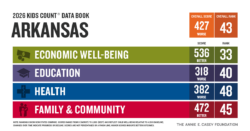
For more than 35 years, the KIDS COUNT Data Book has ranked states on child well-being overall and in four domains: Economic Well-Being, Education, Health, and Family and Community. In 2026, these rankings remain an important tool. However, starting this year, the annual Data Book includes scores alongside the rankings. This addition provides a more robust, useful data tool to guide action and investments that support kids and families.
The 2026 KIDS COUNT Data Book still presents the same 16 indicators across the four domains, with each contributing equally to a state’s ranking. What’s new is a 0-to-1,000 score that shows how far apart states really are, how much room for improvement remains even for top-ranked states, and whether outcomes are improving or declining over time.
While the rankings still provide a quick snapshot, the new scores add essential context, presenting deeper insight into gaps, trends, and progress. Together, they provide a more complete and more accurate picture of how kids are doing and where action is most needed.
The last full year before the pandemic disrupted children’s lives — 2019 — serves as the baseline year to allow comparisons across time. Using this anchor year, the scores demonstrated how child well-being has progressed or declined in each state since then, as the new Data Book provides scores for 2019 through 2024.
The new scores improve our understanding of child well-being:
- They show how far apart states really are
- They reveal serious challenges and room for growth that even top-ranked states may have
- They measure progress or decline over time
The new scores explained:
- Think of the scores as points on a 0-to-1,000 scale, not a percentage
- A score of 1,000 represents the best outcomes observed across states in 2019 — not a finish line; a state with a score of 1,000 still has room for improvement
- A score of 500 doesn’t mean a state is “half as good” as one that scores 1,000, but it does indicate substantial distance from the best outcomes
- When a score goes up, that means child well-being improved since 2019
- When a score goes down, outcomes for kids have worsened
- The benchmark scores do not mean that 2019 outcomes are “good enough;” every state has room for improvement beyond the 2019 levels
Most importantly, the rankings/scores combination provides policymakers and child advocates with better information. The updated methodology makes progress and decline more visible. It helps states see where they are improving and where they are falling behind. It strengthens the Kids Count Data Book as a tool for accountability, learning and action. And finally, the additional of scores allows advocates and leaders to move beyond “Who’s ranked where?” to “What’s changing and what will it take to improve outcomes for kids?”
Overall Well-Being in Arkansas Compared to Other States and Over Time
In the 2026 KIDS COUNT Data Book, Arkansas ranks 43rd in overall child well-being. This ranking originates from the corresponding score of 427. Mapping the scores across the 50 states demonstrates just how far Arkansas (red marker in the below chart) is from the national score, as well as from the best-performing state, New Hampshire. It is also possible to see the other states with similar scores.

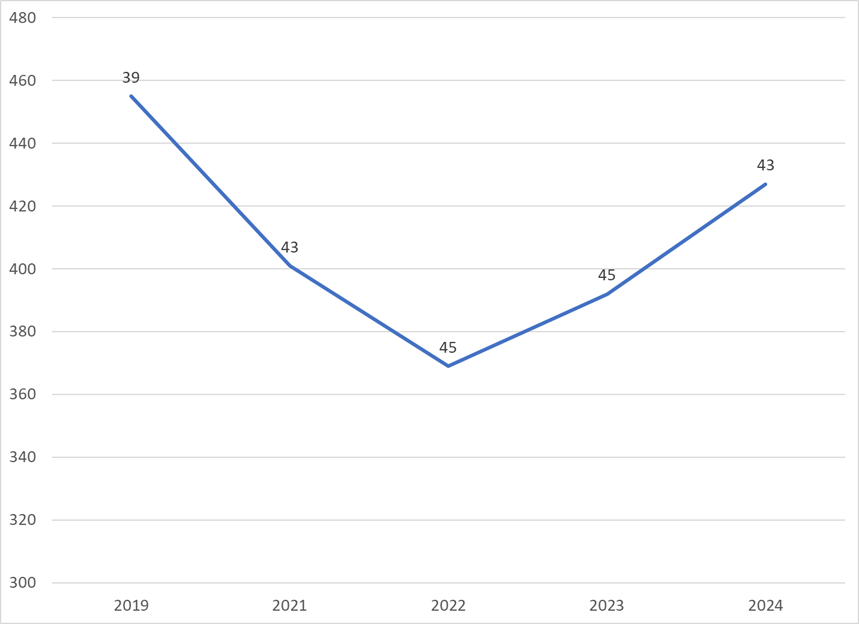
It is also possible to track the Arkansas overall score over time, starting with the 2019 benchmark year. The chart below presents these scores, as well as the corresponding Kids Count Data Book overall ranking for each year. The pandemic was challenging for Arkansas children, and the recovery has been slow. The 2024 score is 28 points below the benchmark year, as we have not yet returned to our pre-pandemic level. The ranking is four spots lower; this indicates that some states have recovered from the pandemic more quickly than Arkansas. Both charts taken together demonstrate much work remains to improve child well-being in the state.
For more detail on how scores are calculated, see the KIDS COUNT full methodology report.