
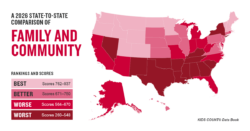
Despite progress made, Arkansas remains 49th in the country for births to teens, 45th for Family and Community Domain
According to the 2026 KIDS COUNT Data Book, Arkansas’s teen birth rate continues to decline, but we still lag behind almost all other states in this critical measure of child well-being. The teen birth rate measures the number of births to teenagers ages 15 to 19 per 1,000 females. Our teen birth rate fell to 22 per 1,000 females in 2024 (the year for which we have the most current data), which reflects a 27% decrease in teen births in Arkansas since 2019. However, teen birth rates have also progressively decreased nationwide, and Arkansas’s progress has not outpaced that of other states. As a result, Arkansas is still 49th in the country for teen births with a rate that is almost double the national teen birth rate of 13.
Further, when the data is disaggregated by race and ethnicity, notable disparities exist. There are higher teen birth rates among Black, Indigenous and other People of Color (BIPOC) youth in Arkansas as shown in the table below. These disparities reflect the complicated intersection between teen pregnancy and poverty, and the systemic challenges and lack of resources that many BIPOC youth in our state face compared to their White counterparts.
| Race | 2024 Arkansas Teen Birth Rate (rate per 1000) | 2024 National Teen Birth Rate (rate per 1000) |
| Asian and Pacific Islander | 19 | 3 |
| Black or African American | 30 | 14 |
| Hispanic or Latino | 24 | 20 |
| Non-Hispanic White | 19 | 8 |
| Two or More Races | 24 | 12 |
| Total | 22 | 13 |
While the overall decline in teen births should not be dismissed, we must be more proactive in addressing teen pregnancy in our state to improve short- and long-term outcomes for moms, babies, and our broader communities. Children born to teens are at a greater risk of pre-term births and low birth weight. Teens with children will face challenges completing high school, with one study showing that only half of 20- to 29-year-old women who gave birth in their teens earning a high school diploma. As such, women who give birth as teens are then less likely to obtain a post-secondary degree or otherwise attain economic mobility and more likely to need public assistance. The repercussions do not stop there. Research shows that children born to teens are more likely to have poorer educational and behavioral outcomes which then affect their economic well-being as adults.
For these reasons, we must implement policies designed to reduce the teen birth rate, because teens in Arkansas are not more sexually active than they are in other states. But Arkansas does not have a requirement for sexual health education to be offered, creating disparities among what students are taught throughout the state, as found in our 2025 survey of school districts and corresponding analysis. Increasing the number of school districts that provide evidence-based, medically accurate, and age-appropriate sexual health education is one strategy that could build on the successes we’ve already achieved. Likewise, increasing access to contraception — particularly highly effective, long-acting contraceptive methods — is another policy that has helped other states make significant strides in reducing teen pregnancies. Other opportunities for improvement are outlined in our Sexual Health Education in Arkansas: A Blueprint for the Future.
In addition to learning from other states about strategies to continue reducing teen pregnancies, it is also imperative that we listen to teens in Arkansas about their ideas. Thanks to the newly established Teen Health Arkansas, there will be a coordinated effort to lift up teen voices regarding a variety of health issues and how to build brighter futures for young people in our state.
There is some additional good news. The teen birth rate is one of the indicators that informs the Family and Community domain for the 2026 KIDS COUNT Data Book. This year Arkansas ranks 45th in the Family and Community domain, which the Annie E. Casey Foundation uses to determine whether children across the country are getting what they need to be successful and to thrive.
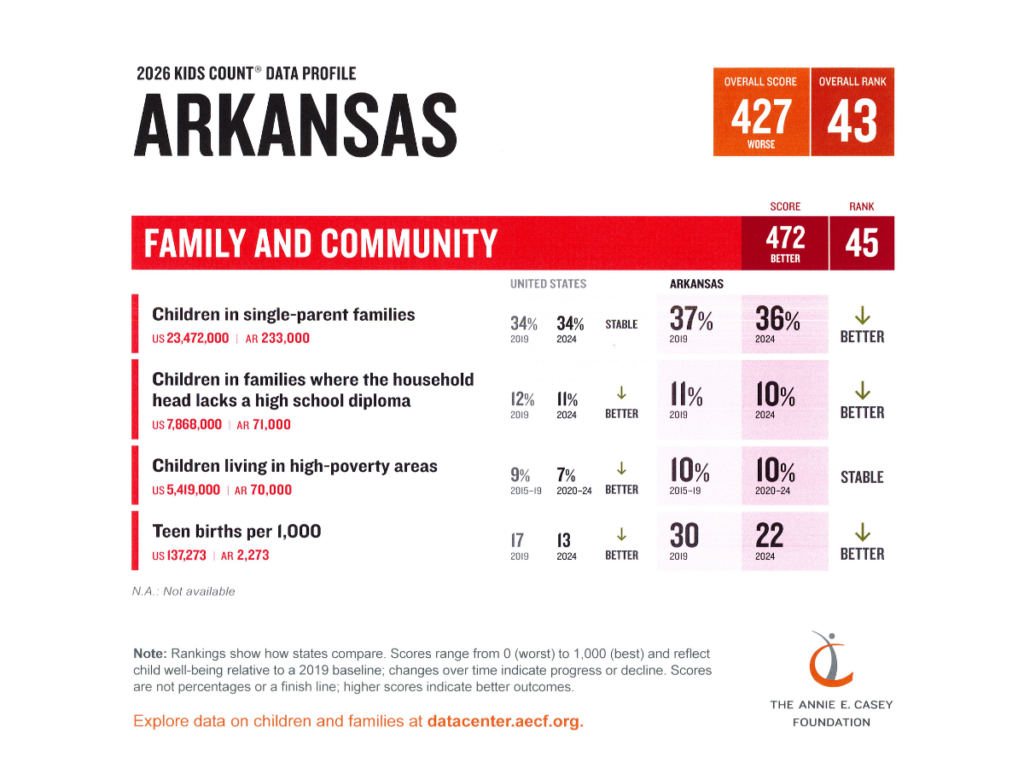
Arkansas’s ranking in the Family and Community domain has essentially remained steady since 2019 with only slight adjustments. However, since 2019, Family and Community is one of two domains in which our state saw an improvement in its score, a new methodology developed by the Annie E. Casey Foundation that is based on a 0-1000 point scale. (Economic Well-Being is the other domain score that improved for Arkansas). The indicator that is largely driving the improvement in Arkansas’s Family and Community score is our steadily improving teen birth rate, given the 27% decline in teen births since 2019.
Arkansas’s Family and Community score for 2024 came in at 472, which represents a 102-point increase since 2019. This newly developed scoring methodology makes it clearer to see how Arkansas is performing in relation to other states. As seen in the figure below, even with a Family and Community ranking of 45, Arkansas scores relatively higher (more than 200 points) than neighbors like Louisiana and Mississippi that are ranked 48th and 49th, respectively. Meanwhile, despite being one ranking ahead of Alabama, the states’ scores are almost identical. And, unfortunately, the distance between Arkansas and the highest performing state of New Hampshire is much more significant with a 465-point differential.

In other words, despite some progress, our work is far from over. However, rather than dwelling on deficiencies, let’s use the data as an impetus to propel us toward proven policies and investments that will translate into better outcomes for kids and families in Arkansas.