

On June 19, Governor Sanders sent a letter to state government cabinet secretaries and department directors “outlining budget expectations” for the 2028-2030 biennial budget. In the letter, the Governor directs agency leaders to “cut costs” and “identify new savings.” All for the unrealistic and harmful goal of eliminating the state income tax.
The governor and legislature have cut the income tax rate four times since 2023. But these cuts date back more than a decade now. Throughout legislative debate, representatives and senators have said over and over that the income tax cuts will not result in reduced services and programs. But continued cuts to revenue, now totaling more than $2.2 billion annually, can only result in reductions in line-item budgets and government employees. Something must give. Are we willing to see decreases in funding for early childhood and K-12 public education? Closures of county health clinics? Less funding for road repairs and improvements? Fewer state police on our highways? Decreased enforcement of our child labor, environmental, and consumer protection laws? Promises to maintain programs and services no longer hold.
First, it is worth noting that the flat budgets over the past several years mean department leaders are already doing more with less, as inflation has eroded the value of unchanging appropriations (a 2019 pre-pandemic $1 is only worth $0.76 today). Second, during the 2026 fiscal session earlier this year, the approved state budget holds back 7% of most departmental budgets from the priority spending category; rather than a strategic approach to prioritizing spending, this blanket percentage tactic is designed to drive budget and income tax cuts. Third, the governor’s letter makes clear her intention to shrink agency budgets.
We all have an interest in continually seeking out efficiencies in the programs and activities provided by the government. But the governor and the legislature have suggested that Arkansas state government is too big. By any objective measure, this simply isn’t true. Using historical data provided by the National Association of State Budget Officers, Arkansas ranks 24th in the country in state expenditures per person. Looking at state operating expenses (referred to as non-capital expenditures), we still rank 24th. This puts us squarely in the middle.
Common sense suggests that the larger a state’s population, the greater the state’s expenditures should be. While there are certainly outlier states — such as Texas and California — most states are remarkably close to the line showing the relationship between expenses and population, as seen in the chart below. Arkansas is right on the line, and many of our neighboring states are quite close. Does it not make sense then, as the governor is touting population growth in our state, that we should be investing in that growth and not withering state government programs and services?
State Non-Capital Expenditures vs. Population (2025)
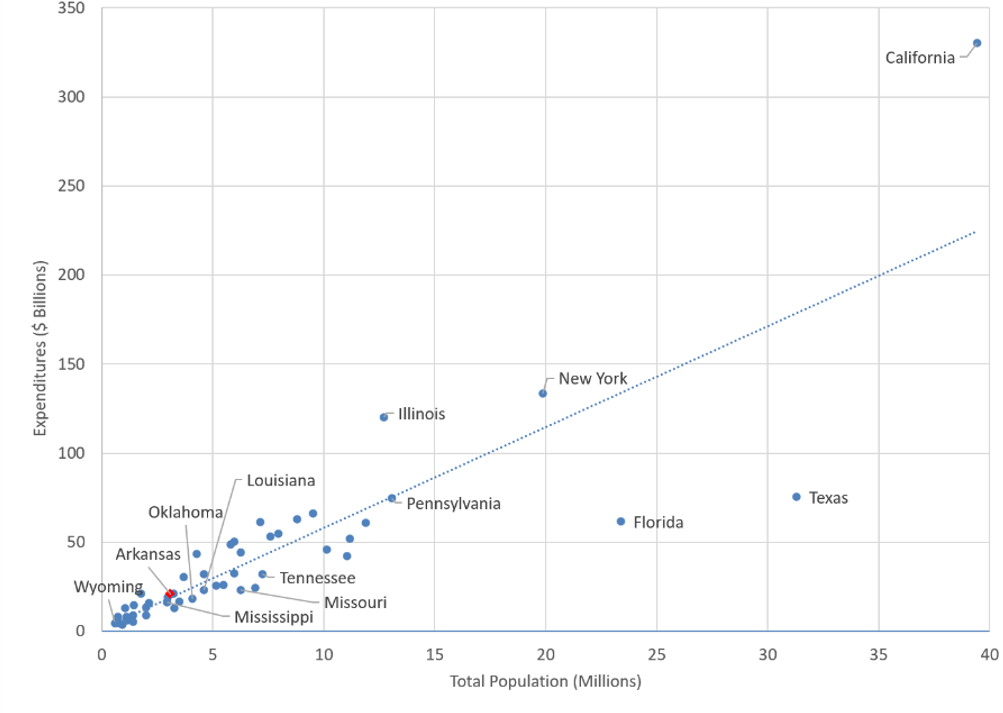
Source: Association of State Budget Officers
While the chart gives us a mathematical technique for comparing state budgets across our nation, it is more important to ask what we want from our state government. We have a lot of challenges in Arkansas, such as our high maternal and infant mortality rates, the worst food insecurity in the country, and an early child care affordability and access crisis. In the just released 2026 KIDS COUNT Data Book, Arkansas ranks 48th in child health wellbeing and 49th in the rate of births to teens. There is much work to do.
In a recent interview, Arkansas State Chamber of Commerce CEO Randy Zook touted Utah as a successful model. Zook said, “[Utah] has well-managed government, not just low taxes, but reasonable, competitive taxes which are vital. They don’t have to be zero … There’s a spot there.” Businesses and individuals looking to move into Arkansas want to see a state in which people and workers thrive. They are interested in investments in health, transportation, education, and child care. It’s time to set aside the dangerous tax-cut axe and instead strategically use our revenues to invest in Arkansans. In the march to no income tax we should all ask: What does zero get us?