
The Arkansas Department of Finance and Administration recently announced a final general revenue budget surplus for Fiscal Year 2026 — the state government year that ended on June 30 — of $655 million. The debate concerning what to do with that surplus has already begun. But as the legislature heads into regular session in January, any budget and tax decisions must consider funding programs and services that Arkansans need.
Since Governor Sanders took office in 2023, she has presided over relatively flat budgets, with most of the budget increases going to pay for Education Freedom Accounts (EFAs), the public tax-dollar vouchers for private and home schooling. This has left very little funding increases for most state government departments, leaving leaders of those agencies struggling to do more with less.
The state general revenue budget for Fiscal Year 2023, the last of Governor Hutchinson’s time in office, totaled $6.024 billion. But since that time the dollar has lost buying power thanks to inflation; one dollar in 2022, when the legislature considered the FY2023 budget, is only worth $0.86 today. To simply keep up with inflation, the FY2027 budget should be $6.969 billion when compared to 2022.
However, the state’s current general revenue budget is $6.705 billion. When we subtract $309 million for EFAs, the budget for everything else is $6.396 billion. The difference between the inflation-adjusted budget and the current budget is $573 million. In other words, the current budget is about 9% less than needed to keep up with inflation.
This $573 million is remarkably close to last year’s budget surplus. In fact, the $655 million surplus becomes $582 when you subtract one-time unusual sources of revenue (tax payments shifted from FY2025 into FY2026 because of disaster-related filing extensions and the tax withholding on the single December 2025 Powerball jackpot winner). The governor and legislature should first fund government appropriately, as budget and income tax cuts are not in the interest of Arkansans.
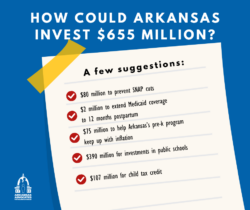
There is much our elected state officials could do with $655 million to help all Arkansans. Here are some of the pressing needs:
- $25 million to fund the Supplemental Nutrition Assistance Program administrative cost share shift from the federal government to Arkansas (and as much as another $55 million in SNAP program costs depending on the state’s SNAP payment error rate going forward)
- Approximately $2 million state match to fully fund Arkansas Medicaid postpartum coverage to 12 months
- $75 million for the Arkansas Better Chance program for early childhood education, just to keep up with inflation (ABC has had a flat budget since 2011); just $22 million would clear 1,500 children from the ABC waitlist and increase provider reimbursement rates to 75% of market levels
- $390 million in targeted investments in per-pupil spending for public schools
- $107 million would provide a fully refundable tax credit of $500 for children under the age of 6 (head of household filers with incomes under $75,000 and joint filers with incomes below $110,000)
There is much the state could do with $655 million. Additional income tax cuts for corporations and high earners won’t get us there. Investments in Arkansas families will.