
One of the most comprehensive reports on state and local finances is produced by the U.S. Census Bureau. State and Local Revenue in FY 2024 (the most recent report) allows an apples-to-apples comparison of the revenue available to each state. State and local government funds are aggregated to allow easy comparisons because revenue and expenditure structures vary from state to state. For example, one state might primarily fund public education through local property taxes, another might fund it primarily through state income and sales taxes, while another might use a combination of local and state revenue (like Arkansas).
When intergovernmental transfers are included — the money provided to state and local governments by the federal government — total revenue in Arkansas is $11,536 per capita (the amount per person). This may sound like a lot of money, but we are far from the top five states, which average $20,733 per person (and while one might expect New York to show in the top five, it is perhaps surprising to also find New Mexico, Alaska, Wyoming, and North Dakota there). In fact, only eight states have a lower per capita general revenue than Arkansas.
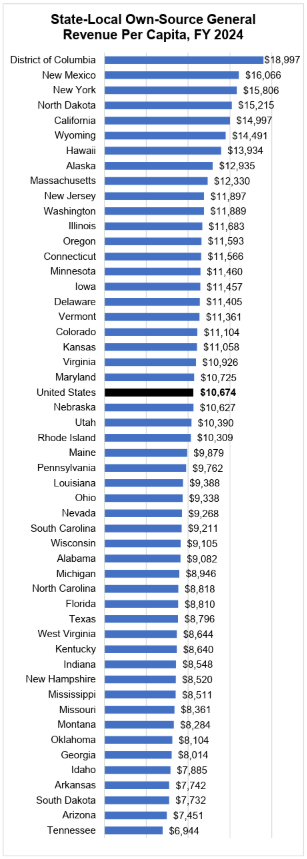
Arkansas achieves the $11,536 mark because it ranks high in federal dollars per capita ($3,794). In fact, almost exactly a third of our total revenue comes from the federal government, ranking us 7th among all states. Without this federal assistance, Arkansas per capita funding drops to $7,742; likewise, our ranking drops to 47th, with only South Dakota, Arizona, and Tennessee ranked lower. This low ranking is not explained by the relatively low income and high poverty rate in the state, as state and local revenue is 13.1% of personal income here. That puts Arkansas 38th and a long way from the top five states that have an average 20.8% state-local revenue as a percent of personal income.
It’s also important to note that total revenue available in Arkansas decreased by $366 per person from fiscal year 2023 to fiscal year 2024. We are among only 11 states to see a decrease. This decrease will continue to accelerate given our state leaders’ choice to prioritize tax cuts primarily for the wealthy and corporations over investments in people. Likewise, the state is only beginning to feel the effects of H.R.1 including decreases in SNAP and Medicaid federal funding.
Does sufficient state-local revenue make a difference? The resounding answer: yes. Take for example the KIDS COUNT Data Book, updated annually. In the 2026 Data Book, which is based on 2024 data, Arkansas ranked 43rd in overall child well-being, a composite index of 16 variables. The score associated with this index has decreased from the pre-pandemic level, from 455 to 427.
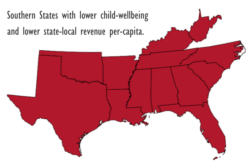
As it turns out — perhaps unsurprisingly — state and local revenue per capita is correlated with child well-being. Among the 25 states ranked lowest on the Kids Count indicator, 17 are also among the 25 states with the lowest per-capita state and local general revenue. In fact, the average per-capita revenue among the bottom 25 states is $8,556, while the average among the top 25 states is $12,204, a difference of more than $3,600 per person. Furthermore, 13 states with both low per-capita revenue and low child well-being appear in the South. Instead of racing to zero income tax — a race to the bottom — Southern states should learn from others and invest in children and their families.
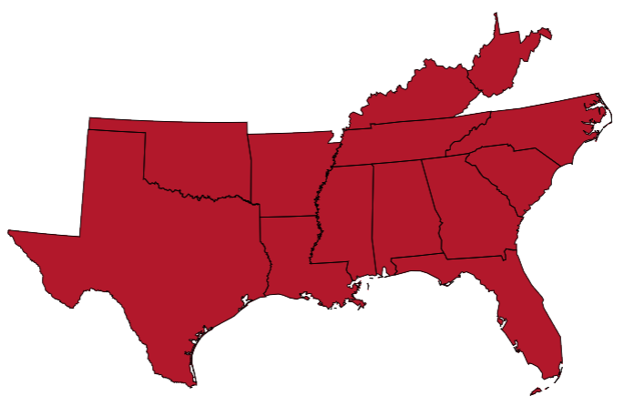
Southern States with lower child-wellbeing and lower state-local revenue per-capita.
There is much the state could invest in to improve well-being for all Arkansans. Early childhood education. K-12 strategic, proven programs. Maternal and infant health. A child tax credit. Anti-hunger initiatives. Paid family and medical leave.
Our taxes make a difference. Let’s use them to invest in people.