
Medicaid is the largest insurer in the United States, and in 2025, around 48% of the program’s enrollees were children. More than 409,000 children in Arkansas are enrolled in Medicaid (known as ARKids First), and thousands of those children receive services paid by Medicaid during a regular school day. Medicaid provides approximately $7.5 billion to schools annually, making the program a crucial part of schools’ budgets.
Because of cuts to Medicaid in H.R. 1, commonly known as the One Big Beautiful Bill Act, and continued state-level attacks on the program, school districts could lose an important piece of their budget. More importantly, children may not receive critical services that improve their development and educational outcomes.
Arkansas schools received more than $80 million from Medicaid last year. These services cover an essential range of health and developmental resources that allow students to learn, communicate, and thrive in the classroom. On average, more than half of students in Arkansas’ public school districts are Medicaid eligible, underscoring the program’s importance to both students and school systems.
Healthy kids do better in school, and school-based Medicaid helps bridge the gap between coverage and care by offering reimbursable services in schools, including therapy services; Early and Periodic, Screening, Diagnostic, and Treatment (EPSDT); audiology services; personal care; school-based mental health services; and additional services as required by a student’s Individual Education Plan (IEP). Some schools in Arkansas also have school-based health clinics on campus that provide a wider range of services to both students and their families. This approach is especially important in rural areas, where provider shortages and transportation barriers often make schools the most reliable and accessible place for children to receive care.
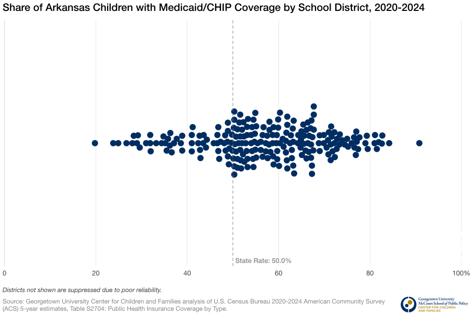
The graph below demonstrates the importance of Medicaid to Arkansas schools by showing that most districts have a Medicaid enrollment rate of 50% or more. Bentonville had the lowest percentage of students enrolled with 19.8%, and Dumas had the highest enrollment with 90.8% of their students enrolled in the program. To see the share of Arkansas children with Medicaid/Children’s Health Insurance Program (CHIP) coverage for your school district, you can access an interactive version of this graph here.
Unfortunately, Arkansas is already experiencing declines in child Medicaid enrollment. Recent data shows that more than 10,000 Arkansas children have lost coverage since January 2025, despite many remaining eligible for coverage. What’s more, the Congressional Budget Office (CBO) anticipates that H.R. 1 will reduce Medicaid enrollment by 7.5 million over the next 10 years. Although the minimum eligibility requirements for children remain largely the same, declining enrollment for eligible children is still likely. Experts warn that children who are eligible will not remain enrolled because of H.R. 1 provisions that impede their parents’ eligibility, or a reversal of what is known as the welcome mat effect, meaning kids who are still eligible for Medicaid are not enrolled due to barriers to their parents’ eligibility or enrollment. Arkansas schools are already underfunded, especially special education services and staff. Medicaid plays a pivotal role in Arkansas schools’ budgets and helps provide services to students that they are entitled to by disability law. If eligible students begin to drop from the program, an incredible strain will be placed on districts because they will still be obligated to provide the therapies and other services.
As we approach the start of another school year, policymakers should remember that Medicaid is not just a line item in the budget but also a lifeline to Arkansas schools and children. When Medicaid disappears from schools, it doesn’t just affect individual students; it weakens the foundation of entire communities because these cuts mean the elimination of school nurses, occupational therapists, and mental health professionals.