
Public education is funded by federal, state, and local money. Approximately 20% of Arkansas’s public education is federally funded, which is higher than the national average of 12.9%. States have a lot of control over their education systems, but federal laws can add requirements states must meet in exchange for the associated federal funding. The primary source of federal aid for K-12 education is through a set of federal laws known as the Elementary and Secondary Education Act (ESEA), which has been around for 60 years. It was most recently updated and reauthorized by the Every Student Succeeds Act (ESSA) in 2015.
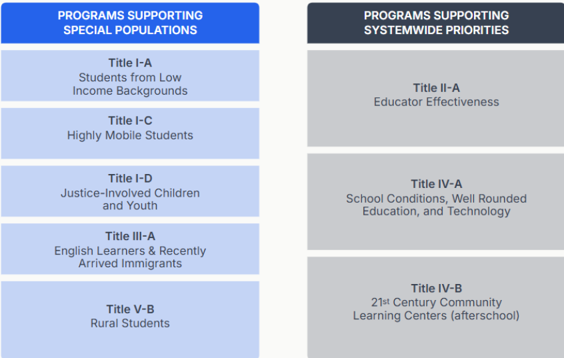
The purpose of ESSA is “to ensure that every child achieves,” meaning to fully prepare them for success in college and careers. Strings are attached to the money to meet that goal. These strings include civil rights protections for students, state standards, student assessment, school accountability, and school improvement requirements, collectively designed to ensure equitable access to educational opportunity for students from all backgrounds. As depicted in the table below, ESSA funds can be spent on programs supporting special populations and programs supporting systemwide priorities, and usually, title funds have to be spent specifically on the type of program the money was designed to support, e.g., the Title III-A funding can only be spent to support English learners and recently arrived immigrants.
ESSA Title Programs Implicated in State Waiver Requests
Waivers allow state educational agencies (SEAs) to request approval from the federal government to do things differently than the law states or to spend money differently than the law describes. This set of federal education laws has included broad waiver provisions since its 1994 update, and those flexibilities were expanded when ESSA was passed in 2015. The flexibilities allow the Secretary of Education to waive many parts of the law and regulations, when requested, but prohibits waivers for certain things, like freezing or ceasing the allocation of funds to certain states. Last summer, the federal administration sent a Dear Colleague Letter to every state encouraging waiver applications and repackaged the flexibility as “returning education to the States.”
Importantly, there are also things that must be in a state’s waiver request, including how the waiver will advance student academic achievement and how schools will continue to provide assistance to the same populations served by programs for which waivers are requested. When it comes to equity in education finance, allocating resources based on student need, such as limited English language proficiency or coming from low-income backgrounds, requires proportionality to meet the varying student needs; more and dedicated funding is needed for certain students. This is equity in practice.
According to the tracker developed by three education organizations and published as ESSA Waiver Watch, 12 states and D.C. have drafted waiver requests, with statuses ranging from withdrawn or awaiting submission to submitted or approved. Over the summer, the U.S. Department of Education (ED) approved the following the flexibilities submitted by the Arkansas Department of Education (ADE):
- ESEA State Plan Amendment for Title I-A
The stated purpose of amending the Arkansas ESEA state plan for Title I-A is to align the written federal plan with what Arkansas is already doing with its accountability and assessment system, which has been overhauled in the past few years. The accountability system and alignment with federal requirements involves how Arkansas identifies schools to receive additional support, monitoring, and oversight. The higher a letter grade or index score under the accountability system, the less monitoring and state involvement a district will have. For additional information, the approval letter from the ED includes a summary of the updates to Arkansas’s state plan.
- Ed-Flex Authority
Ed-Flex authority allows school districts to request flexibilities of the state educational agency, similar to how the SEA requests flexibilities from the federal government. With ed-flex, the ADE has the authority to waive select federal requirements without having to ask the federal government for permission. An example is a waiver for time verifications for staff who are funded from federal grants due to the difficulty and administrative time in tracking down staff to complete the paperwork.
- Returning Education to the States Waiver
This waiver has four components. One component grants more schools eligible for Alternative Fund Use Authority, allowing blocking, or consolidating, two types of title funds. The Waiver also allows block granting state activities funds, high school assessment results to count twice for students taking advanced assessments, and reassigning students who are enrolled in alternative learning environments (ALEs) to their origin school instead for accountability tracking.
Of note, two aspects of the waiver include block granting federal funds. Block granting allows the funding recipient to pool certain funds and reallocate them as desired while still meeting the law’s requirements. For example, the waiver allows more schools in Arkansas to consolidate their funding for Title II-A (for educator effectiveness) and Title IV-A (for school conditions, well rounded education, and technology) instead of having to spend each strand on how it was originally intended. The approved waiver also permits the state to block grant $8.8 million in state-level activities funds over four years from multiple titles, specifically Title II-A, Title III-A, Title IV-A, and Title IV-B. Title III-A includes funding for English Learners and recently arrived immigrants, and Title IV-B is designated as 21st Century Community Learning Centers, which is the federal funding for out-of-school time.
There are concerns about using block grants instead of following the specific provisions in ESEA meant to protect and support students with the greatest need. Namely, pooling funds may decrease transparency and accountability because it is more challenging to assess how the money is used without careful data collection and monitoring. Worries also include changing state activities to no longer fund these priority groups and serving as an indirect means of reducing funding. National advocates continue to raise these concerns because the federal administration has produced budget proposals in the last two years that would radically shift and reduce education funding into a block grant approach.
The Arkansas plan for its Returning Education to the States waiver states spending data will be tracked and requires districts to plan for all student populations, including priority subgroups. However, it lacks specifics on how success will be defined and a description of exactly what will be released to the public. How will we know if the flexibilities have successfully improved student achievement for students the money is supposed to support, like those categorized as economically disadvantaged or for students with disabilities?
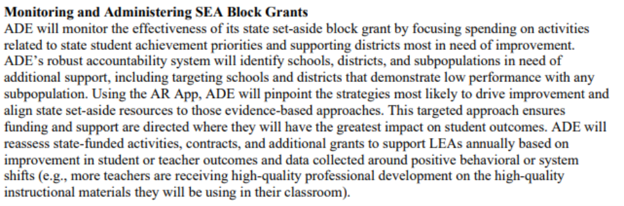
In the portion of the plan that addresses how blocking state activities funds will be monitored, which, as a reminder, is the part of the plan with the most equity concerns, the monitoring portion states:
The updated ESEA state plan sets new achievement goals to reach by 2031 with identified checkmarks by subgroup, which included needed gains for 2026 to be on track to meeting that goal. But when ADE released the 2026 end-of-year ATLAS exam scores in June, the summary document did not list how the test scores corresponded with the goals by subgroup. ATLAS is the statewide student assessment system and stands for Arkansas Teaching, Learning, and Assessment System. Of course, the waivers were not in effect during last school year, so perhaps the detailed information will come with the state’s annual report to ED. But that seems insufficient for public accountability. ADE publishes a lot of education data for the public to view, inspect, and use, such as through the School and District Rating Dashboard. The dashboard allows you to drill down by certain student groups, like by race, on the school or district level, but does not offer that option for statewide results. That’s the level of public transparency and accountability that is needed, particularly as the waivers are in progress for the 2026-2027 school year. To ensure an effective use of the given federal funding and that all students achieve educational success, it will be paramount to closely monitor the data collected and released by ADE as it implements the Returning Education to the States waiver.