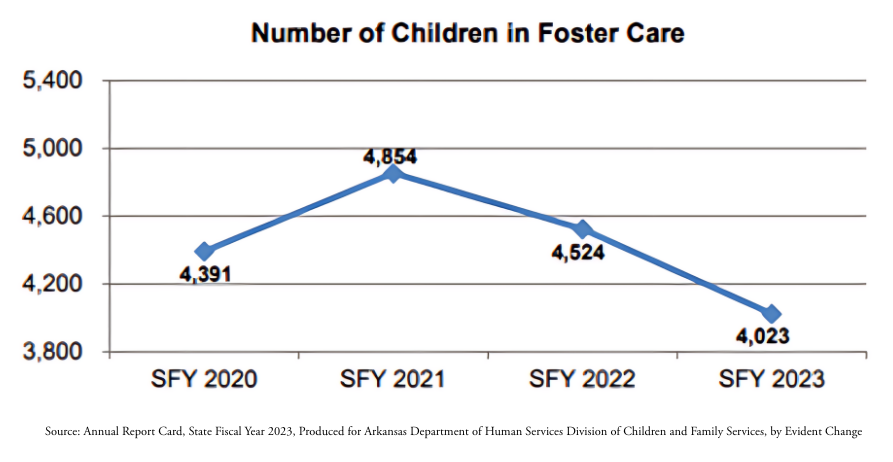
Children placed in foster care and the state’s child welfare system are some of the most vulnerable children in our community. These children are entitled to our protection from further abuse and neglect and to the highest quality of care. This care includes services to the child’s biological family and to the foster families that care for them while in state custody.
Recent Publications:
More Homes for Arkansas Foster Children Available
November 21st 2011
Finding a Forever Family: A Profile of Adopted Arkansas Children and Those Still Waiting for Homes (September 2010)
An analysis of the 3,286 children adopted in Arkansas since 2002 shows that the state has doubled the number of children adopted each year and reduced the length of time they waited in foster care. The data also show that children waited an average of 2.5 years after entering the child welfare system until finding a "forever" family. The state can help foster children get into permanent homes faster by promoting solutions that are already working: ensuring adoptive families are available as soon as a child is legally able to be adopted, mobilizing local groups to recruit families and focusing efforts on older foster children.
Arkansas Child Welfare System Perfomance Reports:
Waiting for Helping Hands: An Analysis of the Arkansas Child Welfare Crisis(December 2008)
Over the past four years, Arkansas Advocates for Children and Families has highlighted the problems with Arkansas's welfare system in our annual report on performance of the child welfare system. This report discusses the ongoing problems within the Arkansas child welfare system. This year's report shows that little has changed in the system's performance on key indicators and that there is much more work to be done within the Division of Children and Family Services to fix these problems.
Children in Crisis: An Update on the Arkansas Child Welfare System (August 2007)
This report examines the Division of Children and Family Services' (DCFS) performance data from January 2000 through March 2007. The data shows that DCFS peformed well on many of its indicators in the early 2000s, but began experiencing a significant decline in performance in 2004, which corresponded with a state-wide shortage of family service workers in 2004 with 23 percent of positions unfilled. Though DCFS has increased its staffing shortage, many of DCFS's performance indicators have not yet shown improvement.
A Long Road Ahead: An Update of the Arkansas Child Welfare System (July 2006)
This report examines performance data from the child welfare system at the Arkansas Department of Health and Human Services (DHHS) from January 2005 through March 2006 on child safety indicators and performance measures related to family preservation and reunification. The report shows that these indicators worsened in 2004 and that significant improvements need to be made so that children and their families do not hang in limbo awaiting help.
Past Child Welfare Publications:
Finding a Family for a Lifetime: Aging Out of the Foster Care System (October 2008)
This report examines the problem facing foster care children when they turn 18 and leave the system without ever finding a permanent home.
Poison, Problem, and Perspective: Revisited (December 2007)
This report is a follow-up to the January 2007 report entitled, Poison, Problem, and Perspective: The Impact of Methamphetamine on the Arknansas Child Welfare System. This report provides updates on the data provided in the original report as well as new information now available as a result of new policies implemented by the Arkansas Department of Human Services Division of Children and Family Services.
Press Release: Annual Report on Arkansas's Child Welfare System Released (August 2007)
Press Release: Study of Meth Impact Uncovers More Problems for Arkansas's Child Welfare System (April 2007)
Children Left Behind: A Study of the Arkansas Child Welfare System (March 2007)
This report is a study of whether disparities existed in how children were treated in the child welfare system based on age, gender, race, ethnicity, and geographic location. The report details how the study was conducted, the study's findings, the challenges encountered during the study, as well as recommendations for future studies.
Poison, Problem, and Perspective: The Impact of Methamphetamine on the Arkansas Child Welfare System (January 2007)
This report is based on a study conducted by Arkansas Advocates for Children and Families that set out to determine the effect that methamphetamine, or "meth," has had on Arkansas's child welfare system. The results of the study brought the author to both interesting and disturbing conclusions about the way the system deals with substance abuse in general.
Press Release: A Long Road Ahead: An Update of the Arkansas Child Welfare System (July 2006)
The Arkansas Child Welfare System: More Than a Decade of Change, Yet Many Things Remain the Same (August 2005)
Special Report: The Changing Faces of Arkansas' Children (October 2001)
Special Report: The Economic Impact of Welfare Reform on Arkansas Families (August 2001)