
Why the Teen Birth Rate Matters
We want all young people in Arkansas to have every opportunity to thrive, and we all want to see improvements in Arkansas’s child well-being indicators like child poverty. But the staggering number of our state’s teenagers giving birth prevents the kind of progress we need to make. Teen births put young people at risk of not finishing high school or earning a college degree, of struggling to provide essential needs for their families. It contributes to health complications in mothers and babies, and to our already too-high child poverty rate.
Arkansas’s Teen Birth Rate
Arkansas’s teen birth rate is substantially higher than the national average (22 per 1,000 compared to 13 per 1,000 nationally). And it’s more than four times as high was the states with the lowest teen birth rate (New Hampshire and Massachusetts, where the rate is 5 per 1,000).
The teen birth rate measures the number of births to teenagers ages 15 to 19 per 1,000 females in this age group. To be fair, there is some good news regarding teen births over time: Arkansas saw a roughly 50% decrease in the teen birth rate between 2013 and 2024 (the year for which we have the most current data). The bad news is that, even with this notable improvement, Arkansas still ranks 49th in the country.
To learn more about Arkansas’s teen birth rate and the consequences of inadequately addressing this issue, please see the following:
- The Kids Count Data Book: Family and Community (7/25)
- Teen Births: A Low Ranking Arkansas Can Actually Change (10/24)
- The Challenge of Arkansas Teen Births: Facing Reality to Lower the Nation’s Highest Rate (10/22)
- Arkansas must change its strategy to prevent teen births (9/22)
- Data: Arkansas needs a different strategy for preventing teen births (6/21)
Sexual Health Education is the Key to Solving Arkansas’s Teen Birth Crisis
The overwhelming majority of Arkansas’s teen births are the result of unintended pregnancies. Research shows that Arkansas teens’ sexual behavior isn’t different from those in other states, but their lack of use of contraceptives stands out.
In 2023, Arkansas Advocates for Children and Families began recruitment for a new Sexual Health Education Coalition. This diverse group represents parents in our state, health providers, abuse prevention experts, and advocates for marginalized groups, who all came together to make recommendations that form a blueprint for change. The group quickly realized that our state has a long way to go to improve access to age-appropriate, effective, and equitable sexual health education. Thinking long-term, coalition members acknowledged that it will take years of incremental steps to improve the quality of education that young people in Arkansas receive, and they developed a Timeline for Action.
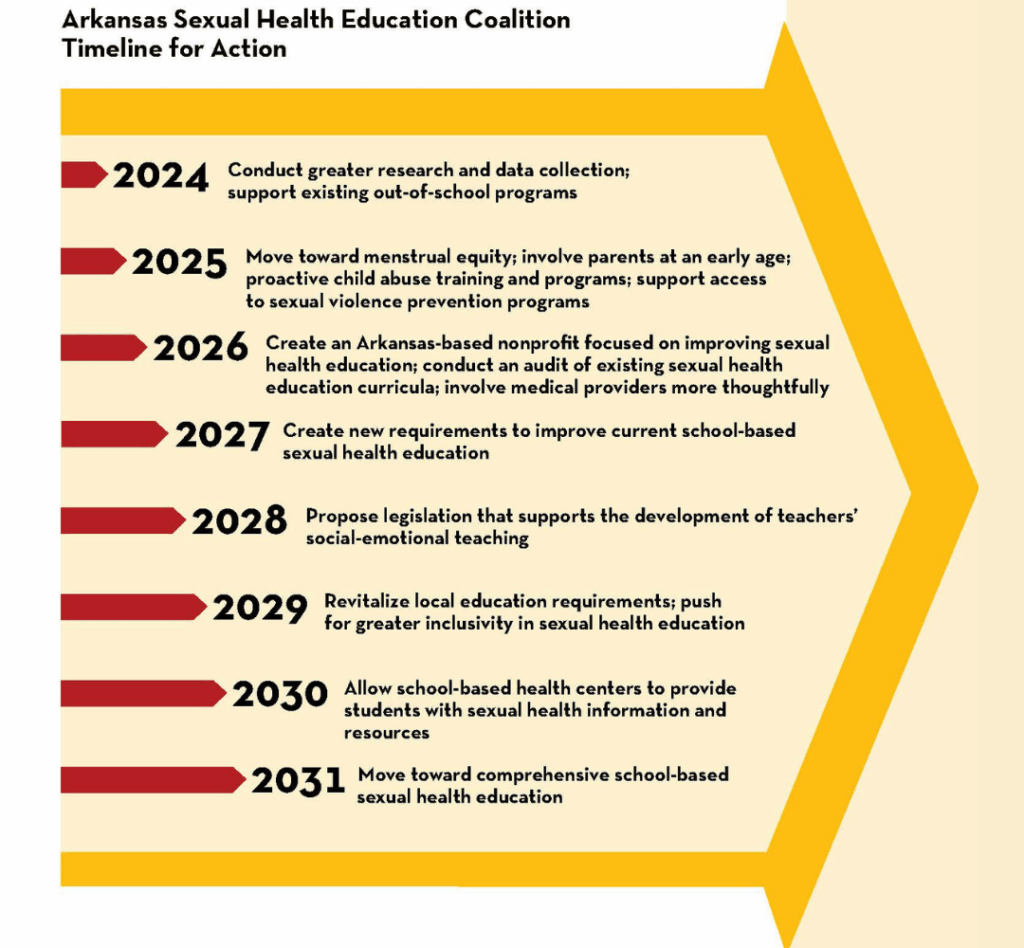
In 2024, Arkansas Advocates published a report, Sexual Health Education in Arkansas: A Blueprint for the Future, which outlines the current landscape for sexual health education in Arkansas and how that compares to best practices nationally. It includes a list of recommendations from community-level services to statewide policy change and a timeline for taking pragmatic action.

In 2025, we published Sex Education in Arkansas: Data Demonstrates Disparity Across School Districts, which analyzed the results of a survey provided to every public school district and open enrollment charter school on what type of sexual health curriculum they offer, if any. The responses results show that most responding districts (64%) offer some sexual education curriculum. But the curricula include a wide range of offerings, with the majority offering abstinence and healthy relationships while a limited number include information about contraceptives, abuse prevention, and sexual orientation.
While there are limitations to the research and analysis of the findings, this report is an important first attempt at quantifying the availability and adequacy of sex health education provided to the majority of Arkansas’s students. To address the persistently high teen birth rates and related public health challenges in Arkansas, Arkansas Advocates will continue following the Blueprint for the Future.
If Arkansas wants to make the kind of progress that other states have seen over the last decade, we should adopt medically accurate, evidenced-based, culturally competent, comprehensive sexual health education, especially targeting high-risk communities. This program will need to be accessible to all young people throughout the state in a variety of settings. If we don’t, we should expect to remain at or near the bottom for the long term.